
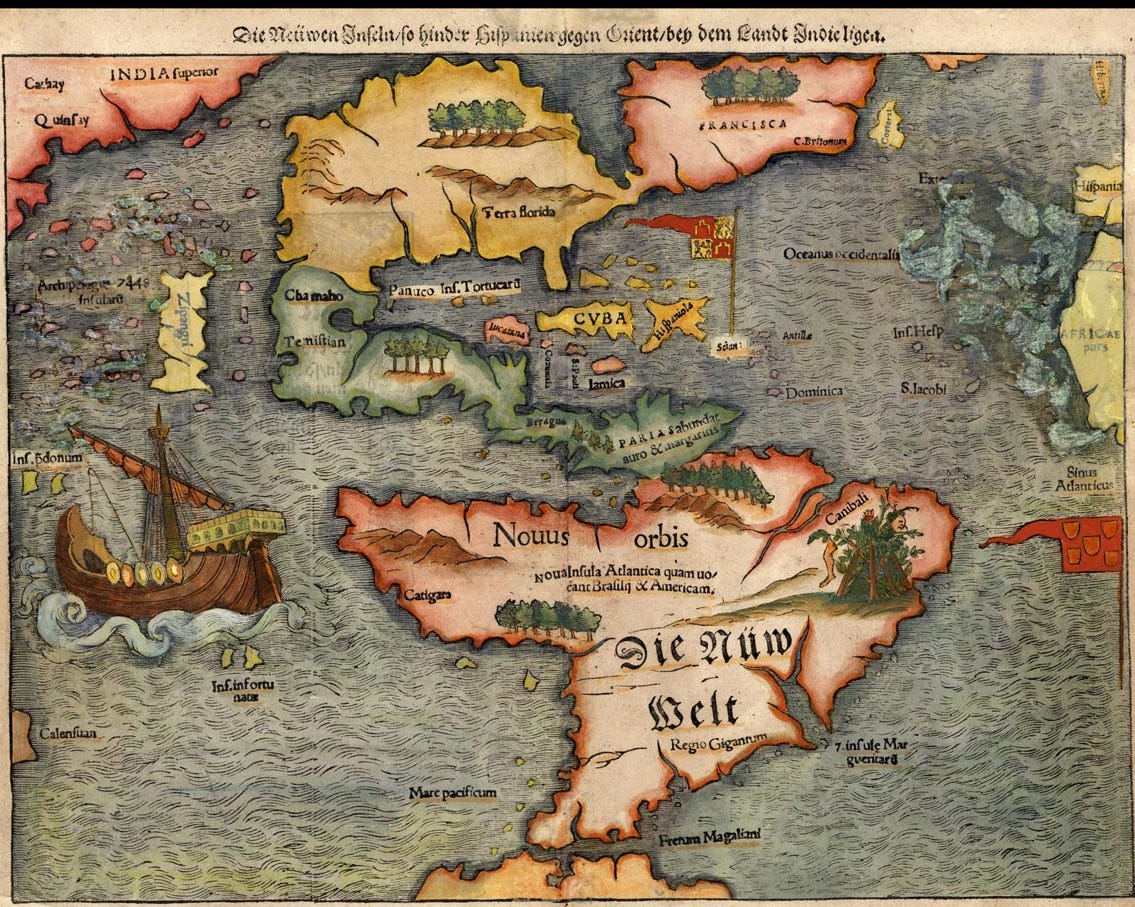
A New World Was Created
'Columbus’s voyage did not mark the discovery of a New World, but its creation'


Posts excerpted from:
A Whirld of Words: A Reader’s Commonplace Dictionary

Join the Conversation!
You will find the WORKS CITED below.
A New World
Columbus’s voyage did not mark the discovery of a New World, but its creation
(Mann 2011) p. xv
Simon Bolívar considered Alexander von Humboldt to be ‘the true discoverer of the New World, who contributed more to America by his studies than all the conquistadores’
(Meyer-Abich 1969) p. 72
the New World in the seventeenth and eighteenth centuries does not live outside Europe but exists inside it as a principle of unlimited political change. Instead of being an isolated region in which history is not yet interested, it is a present influence of the utmost importance to which the historian must be continually alive, an influence which for a long time rivals the Reformation, and from the beginning of the eighteenth century surpassed the Reformation, in its effect upon the politics of the European States. Napoleon did not care about Europe. ‘Cette vieille Europe m’ennuie’, he said frankly. His ambition was all directed towards the New World
(Seeley 1971) p. 84
the system of monopoly in the New World made trade and war indistinguishable from each other
(Seeley 1971) p. 90
America began as a sobering experience. The colonies were a disproving ground for utopias. A new civilization was being born less out of plans and purposes than out of the unsettlement which the New World brought to the ways of the Old. The flavor of American life was compounded of risk, spontaneity, independence, initiative, drift, mobility, and opportunity
(Boorstin 1964) p. 1, 85
whatever else the Lewis and Clark party thought they were accomplishing, they unwittingly garnered the linguistic wealth of a new world in their intimate record of the simultaneous processes of geographic discovery and linguistic invention. Nearly two thousand terms in their vocabulary were in one way or another American novelties; of these at least a thousand words appeared in these journals for the first time
(Boorstin 1965) p. 283
the New World had failed to provide a refuge from the absurdities of history
(Quinn 1994) p. 228
books
Mayan scribes wrote in codices made of folded fig-bark paper or deerskin. Unfortunately for posterity, the Spaniards destroyed all but four of these books
(Mann 2006) p. 303
Colombian Exchange
after Columbus, ecosystems that had been separate for eons suddenly met and mixed in a process Alfred W Crosby called the Colombian Exchange
(Mann 2011) p. xiv
colonialism
the common experience of the New World is colonialism
(Walcott 1998) p. 16
‘colonialism’, David Abernethy writes, ‘is the set of formal policies, informal practices, and ideologies employed by a metropole to retain control of a colony and to benefit from control. Colonialism is the consolidation of empire, the effort to extend and deepen governance claims made in an earlier period of empire building’
(Johnson 2004) p. 29
colonization
the British nation proved to be adept not at the Roman art of empire building but at following the Greek model of colonization
(Arendt 1958) p. 127
democracy
within weeks of each other, Jamestown had inaugurated two of the future United States’ most long-lasting institutions: representative democracy and chattel slavery
(Mann 2011) p. 67
dictionary
in 1953, Webster’s New World Dictionary of the American Language appeared. Edited by David B. Guralnik and Joseph H. Friend, it simplified its technical definitions to make them more understandable to the layman, gave full etymologies, and used no undefined (or ‘run on’), derivatives, a policy changed in later editions
(Landau 1984) p. 73
empire
in 1491 the Inka ruled the greatest empire on earth. Bigger than Ming Dynasty China, bigger than Ivan the Great’s expanding Russia, bigger than Songhay in the Sahel or powerful Great Zimbabwe in the West Africa tablelands, bigger than the cresting Ottoman Empire, bigger than the Triple Alliance (as the Aztec empire is more precisely known), bigger by far than any European state. The Inka language was Ruma Sumi. The Inka developed a form of writing unlike any other, sequences of knots on strings that formed a binary code reminiscent of today’s computer languages. The Inka empire began in the fifteenth century and lasted barely a hundred years before being smashed by Spain
(Mann 2006) p. 71, 75
ecological imperialism, Alfred W Crosby argued, provided the British, French, Dutch, Portuguese, and Spanish with the consistent edge needed to win their empires
(Mann 2011) p. xv
exchange
the economic system for exchange ended up transforming the globe into a single ecological system by the nineteenth century. The most consequential exchange of all: the slave trade
(Mann 2011) p. xvi, xviii
Fourteenth Century
the fourteenth century was an age of great mystics, and of prophetesses. The fourteenth century has often in the past appeared to historians as a century of disasters and decline, notable only for its savage warfare and its sterile controversies, crowned by the débâcle of the papacy and the futile maneuvers of the conciliarists. Seen from another, and perhaps a less superficial angle, it is one of the most genial centuries in European history, in which the fields of art, literature, natural and political science, and even of theology, were fertilized by achievements and ideas that were to give foundations to a new world, the world of ‘modern Europe’
(Knowles 1962) p. 332, 333
history
the pulse of New World history is the racing pulse beat of fear, the tiring cycles of stupidity and greed
(Walcott 1998) p. 39
Homogenocene
a new epoch in the history of life, brought into being by the abrupt creation of a world-spanning economic system. Colón’s voyages marked the beginning of a new biological era: the Homogenocene. The term refers to homogenizing: mixing unlike substances to create a uniform plan. With the Colombian Exchange, places that were once ecologically distinct have become more alike. It is more often called the Anthropocene
(Mann 2011) p. 17, 25, 416
Industrial Revolution
three fundamental materials were required for the Industrial Revolution: steel, fossil fuels, and rubber
Susanna Hecht (Mann 2011) p. 248
Ferdinand Magellan
news of the successful circumnavigation of the globe was quickly relayed to the rest of Europe by several participants in the voyage, by excited Spanish writers, and by foreign diplomats in Spain. The Latin report by Maximilian of Transylvania was the first to be published; it appeared at Cologne and Rome in 1523. The return of the ‘Victoria’ should have produced much more of a revolution in Europe’s view of the world than it actually did. The Magellan adventure did serve to remove all remaining doubts about the sphericity of the earth. It corrected the Ptolemaic proportions of water to land on the earth’s surface and proved that the land far exceeded the water area. The vast width of the Pacific ocean was established and the knowledge began to spread that Asia and America, at least in their southern reaches, were very far apart. The Magellan voyage contributed also to a growing belief in the unity and independence of the Americas as the New World. It dispelled forever all the ideas that Asia could be reached by a relatively brief westward voyage. Magellan’s passage around America secured an access to the Pacific by sea. But it still left open the question of a land connection between North America and northeastern Asia, an issue that would not be resolved until the time of Bering in the eighteenth century
(Lach 1977) p. 457, 459
Ferdinand Magellan’s 1519 expedition was heavily funded by German merchants. Magellan’s voyage was a political triumph. The globe which Magellan used to ‘sell’ his projected voyage to the Spanish had been made by Martin Behaim in 1492. It had been commissioned in 1490 by the city fathers of Nuremberg and produced as a piece of German commercial sponsorship, part of a plan to extend German trading involvement along the west coast of Africa. Armed with Behaim’s cartographically precise globe, with its functional commercial annotations, the Nuremberg merchants set out to raise the backing for an expedition westwards, in search of an alternative access route to the coveted spice Islands
(Jardine 1996) p. 292, 295, 298
modern
next to the discovery of the New World, the recovery of the ancient world is the second landmark that divides us from the Middle Ages and marks the transition to modern life
(Acton 1961) p. 78
modernity is a patchy thing, a matter of shifting light and dark upon the globe
(Mann 2011) p. 328
molasses
the first and most famous triangle of trade linked Britain to Africa and to the New World. The second triangle functioned in a manner contradictory to the mercantilist ideal. From New England went rum to Africa, whence slaves to the West Indies, whence molasses back to New England (with which to make rum). A curious blend of slavery and the expanding world market for plantation commodities – what the Trinidadian historian Eric Williams once called a system combining the sins of feudalism with those of capitalism, and without the virtues of either. ‘I know not why we should blush to confess that molasses was an essential ingredient in American independence,’ wrote John Adams in 1775
(Mintz 1986) p. 43, 60, 256
Pangaea
two hundred and fifty million years ago the world contained a single landmass known to scientists as Pangaea. Geological forces broke up this vast expanse, splitting Eurasia and the Americas. Colón’s signal accomplishment was, in the phrase of historian Alfred W Crosby, to reknit the seams of Pangaea
(Mann 2011) p. 6
potato
many scholars believe that the introduction of S. tuberosum to Europe was a key moment in history. This is because their widespread consumption largely coincided with the end of famine in northern Europe. More than that, the celebrated historian William H McNeill has argued, S. tuberosum led to empire: ‘Potatoes, by feeding rapidly growing populations, permitted a handful of European nations to assert dominion over most of the world between 1750 and 1950.’ The potato fueled the rise of the West. In the century after the potato’s introduction Europe’s numbers roughly doubled
(Mann 2011) p. 198, 211
Seventeenth Century
the immigrants settling in America at the start of the seventeenth century somehow unlocked the democratic from all those other principles it had to contend with in the old communities of Europe and they transplanted that alone to the New World, where it has been able to grow freely and develop its legislation peacefully by moving in harmony with the country’s customs. The general principles upon which modern constitutions are founded were hardly grasped by the majority of seventeenth-century Europeans; they were not completely established even in Great Britain, yet were accepted and settled by the laws of New England. On the continent of Europe at the beginning of the seventeenth century, absolute monarchy every where stood triumphant on the ruins of the oligarchic and feudal liberty of the Middle Ages. At the heart of this splendor and literary excellence, the idea of rights had perhaps never been more entirely neglected. Never had nations enjoyed less political activity. Never had ideas of true liberty less preoccupied people’s minds. It was at that very time that these same principles, unknown or neglected by European nations, were being proclaimed in the deserts of the New World to become the future symbol of a great nation
(Tocqueville 2003) p. 23, 51, 54
slavery
slavery was the foundational institution of the modern Americas. Between 1680 and 1700, the number of slaves suddenly exploded. Virginia’s slave population rose in those years from three thousand to more than sixteen thousand – and kept soaring thereafter. In the same period the tally of indentured servants shrank dramatically. It was a pivot in world history, the time when English America became a slave society and England became the dominant player in the slave trade
(Mann 2011) p. 92, 287
stoicism
the Stoic school of antiquity was preceded by the Cynic. Stoicism has been called ‘Cynicism adapted to the purposes of civilization’. Stoicism has no proper place in its scheme for Love. Stoicism can only picture the end of all things as the reabsorption of the precipitated matter into the fire of God, to be followed by the creation of a new world, and so on ad infinitum
(Willey 1964) p. 58, 59
sugar
sugar penetrated social behavior and, in being put to new uses and taking on new meanings, was transformed from curiosity and luxury into commonplace and necessity. The Arab expansion westward marked a turning point in the European experience of sugar. Between the defeat of Heraclius in 636 and the invasion of Spain in 711, in less than a single century, the Arabs established the caliphate in Baghdad, conquered North Africa, and began their occupation of major parts of Europe itself. Sugar making, which in Egypt may have preceded the Arab conquest, spread in the Mediterranean basin after that conquest. Sugarcane was first carried to the New World by Columbus on his second voyage, in 1493; he brought it there from the Spanish Canary Islands. Cane was first grown in the New World in Spanish Santo Domingo; it was from that point that sugar was first shipped back to Europe, beginning around 1516. Spain pioneered sugar cane, sugar making, African slave labor, and the plantation form in the Americas. Sugar – or rather, the great commodity market which arose demanding it – has been one of the massive demographic forces in world history . A rarity in 1650, a luxury in 1750, a virtual necessity by 1850
(Mintz 1986) p. xxix, 23, 32, 71, 148
the Crusaders for the first time encountered ‘reeds filled with a kind of honey known as Zucar’. As important as sugar itself was its manner of production: plantation agriculture. A plantation is a big farm that sells its harvest in faraway places. To maximize output, plantations usually plant a single crop on big expanses of land. The big expanse requires a big labor force, especially during planting and harvesting. Plantations as a rule consist of a lot of land near a port or highway with an attached industrial facility and a pool of laborers. Sugar is the plantation product par excellence
(Mann 2011) p. 290
United States
the New World of the United States. This young people, enterprising and more practical than intelligent, is so busy building its own dwelling-place that it knows nothing at all of our agonies. Moreover, there are not two cultures there. The persons who constitute the classes in the society of that country are constantly changing, they rise and fall with the bank balance of each. The sturdy breed of English colonists is multiplying fearfully; if it gets the upper hand people will not be more fortunate for it, but they will be better contented. This contentment will be duller, poorer, more arid than that which hovered in the ideals of romantic Europe; but with it there will be neither Tzars nor centralization, and perhaps there will be no hunger either. Anyone, who can put off from himself the old Adam of Europe and be born again a new Jonathan, had better take the first steamer to some place in Wisconsin or Kansas; there he will certainly be better off than in decaying Europe
(Herzen et al. 1968) p. 745
U.S. Constitution
slavery was the original sin in the New World garden, and the Constitution did more to feed the serpent than to crush it
(Amar 2005) p. 20

Reading is our common cause, our mutual affection
Please consider the abundant pleasures to be derived from a paid subscription
Tolle lege!
WORKS CITED
Acton, John Emerich Edward Dalberg (1961), Lectures on Modern History (New York: Meridian Books) 319.
Amar, Akhil Reed (2005), America’s Constitution: A Biography (New York: Random House) xii, 657.
Arendt, Hannah (1958), The Origins of Totalitarianism (2d enl. edn.; New York: Meridian Books) 520.
Boorstin, Daniel J. (1964), The Americans: The Colonial Experience (New York: Vintage Books) 434.
--- (1965), The Americans: The National Experience (New York: Vintage Books) 517.
Herzen, Aleksandr, Garnett, Constance, and Higgens, Humphrey (1968), My Past and Thoughts: The Memoirs of Alexander Herzen: Vol. 2, 4 vols. (New York: Knopf) vi, 389-1019.
Jardine, Lisa (1996), Worldly Goods: A New History of the Renaissance (New York: Nan A. Talese) xxvi, 470.
Johnson, Chalmers (2004), The Sorrows of Empire: Militarism, Secrecy, and the End of the Republic (New York: Metropolitan Books) 389.
Knowles, David (1962), The Evolution of Medieval Thought (New York: Vintage Books) 356.
Lach, Donald F. (1977), Asia in the Making of Europe, Vol. II A Century of Wonder: Book Three, The Scholarly Disciplines (Chicago: University of Chicago Press) xii, 395-764.
Landau, Sidney I. (1984), Dictionaries: The Art and Craft of Lexicography (New York: Scribner) xiii, 370.
Mann, Charles C. (2006), 1491: New Revelations of the Americas Before Columbus (New York: Vintage) xiii, 541.
--- (2011), 1493: How Europe’s Discovery of the Americas Revolutionized Trade, Ecology and Life on Earth (London: Granta) xix, 535.
Meyer-Abich, Adolf (1969), Alexander von Humboldt, 1769-1969 (Bonn, Germany: Inter Nationes) 171.
Mintz, Sidney Wilfred (1986), Sweetness and Power: The Place of Sugar in Modern History (New York: Penguin Books) xxx, 274, 12 p. of pl.
Quinn, Arthur (1994), A New World: An Epic of Colonial America from the Founding of Jamestown to the Fall of Quebec (Boston: Faber and Faber) xi, 534.
Seeley, John Robert (1971), The Expansion of England (Chicago: University of Chicago Press) xxvii, 248.
Tocqueville, Alexis de (2003), Democracy in America: and Two Essays on America (London: Penguin) lii, 935.
Walcott, Derek (1998), What the Twilight Says: Essays (New York: Farrar, Straus, and Giroux) 245.
Willey, Basil (1964), The English Moralists (London: Chatto and Windus) 318.