
Alphabets Tell Stories
Alphabets love language

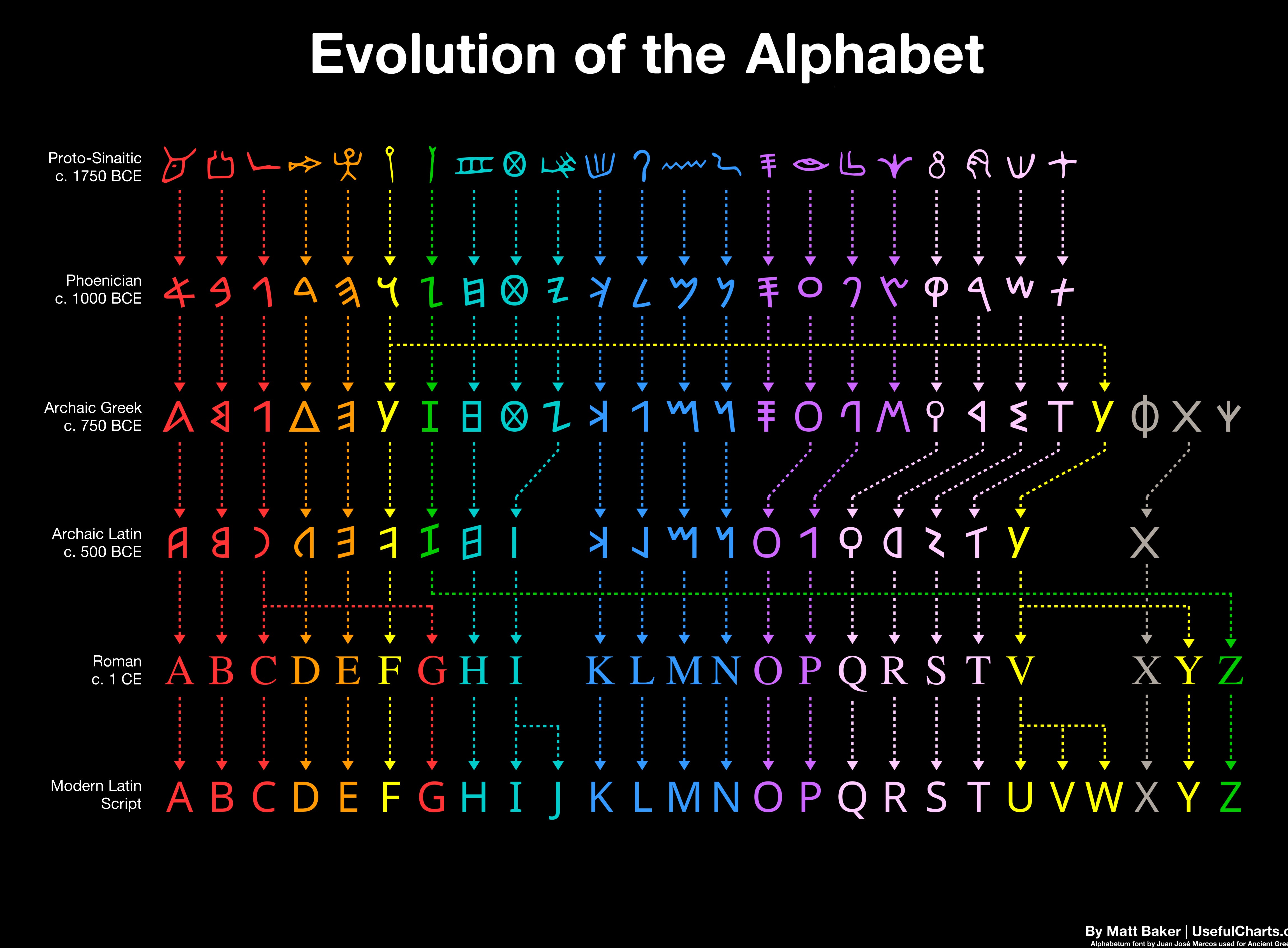

Excerpted from A Whirld of Words: A Reader’s Commonplace Dictionary.
Find the LINK to the Introduction and WORKS CITED below.
alphabet
the first alphabetic systems were developed in the trading cities of Phoenicia in the second millennium BC. They were based on signs for consonants borrowed from Egyptian hieroglyphics. Letters for vowels were not used until the time of the classical Greeks
(Christian 2004) p. 276
the Phoenicians who came with Cadmus, brought to Greece, when they settled in it, various matters of learning and, very notably, the alphabet, which in my opinion had not been known to the Greeks before. At first the Phoenicians used the same letters as all the other Phoenicians; but, as time went on, as they changed their language, they also changed the shape of the letters. The Greeks who lived around about the Phoenicians at this time were mostly Ionians. They learned the alphabet from the Phoenicians, and, making a few changes in the form of the letters, they used them and, in using them, they called the letters 'Phoenicians' (the word for letters being simply phoinikeia, 'Phoenician things'). This was but just, inasmuch as it was the Phoenicians who had brought the letters to Greece. The Ionians also from ancient times called books (Bybloi, which means 'papyri') 'skins' because, from lack of papyrus, they used goat and sheep skins. Still in my time many of the barbarians write on skins in this fashion. I myself have seen Cadmean letters in the shrine of Ismenian Apollo in Thebes in Boeotia. These are engraved on certain tripods and in many respects are akin to Ionic letters. Two of the tripods have inscriptions in hexameters
(Herodotus and Grene 1987) p. 379
from an historical point of view, 'alphabet' and 'Greek alphabet' are one and the same. The Greek alphabet was the first writing that informed the reader what the words sounded like, whether or not he knew what the words meant. The word 'alphabet' itself is Greek, formed from the Greek names of the first two signs in the series; the Greek alphabet was created about 800 BC. The Greek alphabet seems to have originated in a single place at a single time, invented by a single man. The ancient Greek alphabet was a rigorous phonetic system. In archaic Greece, a fundamental principle of writing was that the written word should faithfully reflect the way the word was spoken. The Greek alphabet may have been fashioned explicitly in order to record heroic, hexametric verse, as suggested by H.T. Wade-Gery
(Powell 1996) p. 3, 20, 109, 117
at least by the fifth century AD, if not earlier, the Hebrew alphabet was reckoned by Jews to be sacred in itself: the tabernacle had been created out of the letters, each letter had a symbolic meaning, every stroke made by a scribe in the creation of a text had its significance
(Bowman and Woolf 1994) p. 101
ancient writers held various opinions regarding the origin of writing and the alphabet; Herodotus remarked simply that the Phoenicians, who came to Greece with one Cadmus, introduced it there, amongst other arts
(Driver 1948) p. 128
the ascription of the alphabet to the Phoenicians was firmly embedded in Greek historical tradition as found in the works of the fifth-century BC Greek historian Herodotus. The letters are called phoinikeia grammata (φοινικήια γράμματα), 'Phoenician letters', and were supposed to have been brought to Greece by the legendary Kadmos
(Hooker 1990) p. 229
Herodotus was wrong about Kadmos, founder of the legendary House of Thebes, who should belong to the end of the Middle Bronze Age (c.1600 BC?), far too early for the invention of the Greek alphabet
(Powell 1996) p. 9
for Aeschylus, Prometheus was the alphabet's inventor
(Powell 1996) p. 6
Claudius added three new letters of his own invention to the alphabet, maintaining that they were most necessary; he had written a book on the subject before his accession, and afterwards met with no obstacle in getting the letters officially adopted. They may still be found in a number of books and in public records and inscriptions. The three letters were an upside-down F, used to represent the sound ‘w’; one that resembled the first half of H, apparently used to represent the sound of the Greek upsilon; and probably a backwards C, used for the combination ‘bs’. Examples of the first two letters survive in a few inscriptions, although they all quickly fell out of use after Claudius’ death
(Suetonius 2007) p. 204, 370
the human race has adopted four main methods of making records or communicating information: pictograms, word-signs, syllabic signs and the alphabet
(Hooker 1990) p. 6
writing by means of a relatively simple alphabetic system became the foundation of European and Middle Eastern culture, replacing the oral traditions which had existed for millennia before; the earliest alphabetic inscriptions were written around 1700 BC; the alphabetic principle in writing – the achievement is essentially the insight that writing would be most easily organized if each distinct single sound of a particular language were represented by a single distinctive sign; the true alphabet in our modern sense came into existence when the Greeks, who seem to have got their idea of the alphabet and the main letter-forms from the Phoenicians, began to use certain signs, ones which they did not need for consonants in Greek, to represent the vowels
(Hooker 1990) p. 200-203
the Semitic origin of the Greek alphabet is beyond question; the greatest contribution of the Greeks was the addition of vowels to the alphabet; we owe the alphabet to the Semites, the vowels to the Greeks, and the letter forms as well as the transmission of the alphabet to the Romans
(Ullman and Brown 1980) p. 20, 23, 217
St Patrick arrived in Ireland in 432 bringing religion and the Roman alphabet
(Lerner 1998) p. 40
Ulfilas translated the Scriptures into Gothic, after he had fashioned a Gothic alphabet derived partly from the Greek, partly from the runes of the Northmen
(Laistner 1931) p. 20
the Anglo-Saxon settlers brought with them from Germany the runic alphabet and there survives a small corpus of runic inscriptions on stone and on portable objects; it appears that Latin and the Roman alphabet were first introduced into the Anglo-Saxon areas of Britain by foreign missionaries from the later sixth century onwards
(McKitterick 1990) p. 36, 38
the Irish ogam alphabet was particularly well adapted for writing on the edges of objects
(McKitterick 1990) p. 21
extensive alphabetical glossaries and dictionaries were a uniquely medieval innovation
(Saenger 1997) p. 91
the elaboration of the Korean Han'gŭl alphabet under King Sejong in 1446
(Fischer 2003) p. 112
in Korea, the Hangul alphabet was developed by the fifteenth-century monarch Sejong (1397-1450), and is still used; made up of fourteen signs for consonants and ten for vowels, the Hangul alphabet constitutes ‘one of the most scientific writing systems ever invented’ (Meggs and Purviss)
(De Looze 2016) p. 18
Benjamin Franklin designed a phonetic alphabet during his late-1760s stay in London
(Turner 2012) p. 249
a phonetic Deseret Alphabet contained one letter or symbol for each sound in the English language, mostly containing symbols with no resemblance to Latin letters. Brigham Young authorized the publication of a primer, dictionary, and the Book of Mormon in the Deseret Alphabet
(Turner 2012) p. 249
‘Well, Pip,’ said Joe, ‘be it so or be it son't, you must be a common scholar afore you can be a oncommon one, I should hope! The king upon his throne, with his crown upon his ed, can't sit and write his acts of Parliament in print, without having begun, when he were a unpromoted Prince, with the alphabet.—Ah!’ added Joe, with a shake of the head that was full of meaning, ‘and begun at A too, and worked his way to Z. And I know what that is to do, though I can't say I've exactly done it.’ There was some hope in this piece of wisdom, and it rather encouraged me
(Dickens 1989) p. 66

Reading is our common cause.
Thank you for your support.
Subscribe for full access to the Whirld Commonplace Library.
WORKS CITED
Bowman, Alan K. and Woolf, Greg (1994), Literacy and Power in the Ancient World (New York: Cambridge University Press) ix, 249.
Christian, David (2004), Maps of Time: An Introduction to Big History (Berkeley: University of California Press) xxii, 642.
De Looze, Laurence (2016), The Letter and the Cosmos: How the Alphabet Has Shaped the Western View of the World (University of Toronto Press) xvii, 49 figures, 218.
Dickens, Charles (1989), Great Expectations (New York: Oxford University Press) xvi, 460.
Driver, Godfrey Rolles (1948), Semitic Writing from Pictograph to Alphabet (The Schweich Lectures of the British Academy; London: Oxford University Press) xvi, 222.
Fischer, Steven R. (2003), A History of Reading (London: Reaktion) 384.
Herodotus and Grene, David (1987), The History (Chicago: University of Chicago Press) x, 699.
Hooker, J. T. (1990), Reading the Past: Ancient Writing from Cuneiform to the Alphabet (Berkeley: University of California Press) 384.
Laistner, M. L. W. (1931), Thought and Letters in Western Europe, A.D. 500 to 900 (New York: Cornell University Press) ix, 354, 1 l. incl. front. (map).
Lerner, Frederick Andrew (1998), The Story of Libraries: From the Invention of Writing to the Computer Age (New York: Continuum) 246.
McKitterick, Rosamond (1990), The Uses of Literacy in Early Mediaeval Europe (New York: Cambridge University Press) xvi, 345.
Powell, Barry B. (1996), Homer and the Origin of the Greek Alphabet (New York: Cambridge University Press) xxv, 280.
Saenger, Paul Henry (1997), Space Between Words: The Origins of Silent Reading (Stanford, Calif.: Stanford University Press) xviii, 480.
Suetonius (2007), The Twelve Caesars, trans. Robert Graves and J.B. Rives (Revised edn.; New York: Penguin) xli, 398.
Turner, John G. (2012), Brigham Young, Pioneer Prophet (Cambridge, Mass.: Harvard University Press) viii, 500.
Ullman, B. L. and Brown, T. Julian (1980), Ancient Writing and Its Influence (Toronto: University of Toronto Press) xviii, 240, 16 p. of pl.
I love the way he bridges cultures and eras—from Phoenicia to Greece, Rome, Korea, and even Franklin’s phonetic tinkering—showing that writing systems are both deeply practical and profoundly cultural. Each alphabet carries with it a philosophy of thought, a worldview, a way of ordering reality.
Reading this makes me think differently about the act of writing itself. Every time we form a letter, we’re interacting with a story far bigger than ourselves—a story of human curiosity, ingenuity, and the desire to be understood across time and space. Jerome really captures that sense of wonder beautifully.