
Persona ‒ Mask
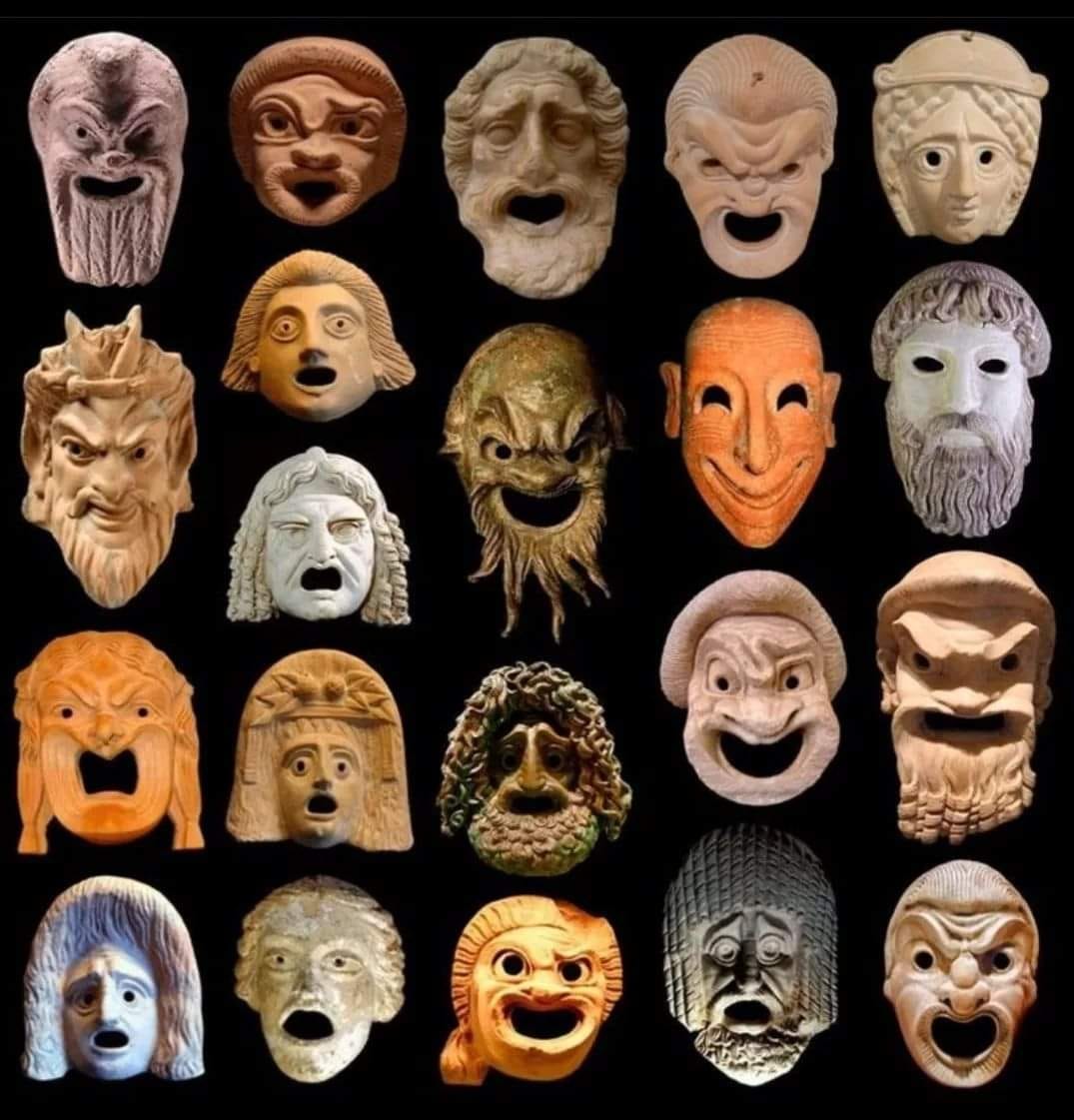
Persona originally meant a mask


Posts excerpted from
A Whirld of Words: A Reader’s Commonplace Dictionary
You will find the WORKS CITED below.
person
the word person has an interesting history. The Latin word persona originally meant a mask. The sound (sonus) came through (per) the mask, which all characters in ancient plays – comedies and tragedies – wore
(Hines and Welch 1962) p. 10
what is most perfect in all nature; a subsistent individual of a rational nature
(Aquinas 1990b) p. 164
the [14th] Amendment to the Constitution which defined more clearly the rights and privileges of human persons was the one used in our law courts to defend the privileges and property rights of corporations; in other words, what was to be a safeguard for the rights of human persons became the bulwark of the immunities and privileges of legal persons; this helped to raise mere ownership to a right standing high above other human rights, and that made ownership the outstanding absolute right of our super-capitalistic age
(Michel 1987) p. 40
it was common law judges who first perceived the desirability of allowing corporations to be parties in cases, and since the common law delights in the use of legal fictions by which to maintain that things which have changed have not changed, instead of merely ruling that corporations could sue and be sued in certain kinds of cases, they muddied the waters by inventing the concept of the artificial person
(Beth 1971) p. 172
in a startling dissent in Connecticut General Life Insurance Co. v. Johnson, 303 U.S. 77, 83 (1938), Justice Hugo Black argued that the Court should return to the original historic meaning of the due process clause of the Fourteenth Amendment and wipe off half a century of unwarranted gloss during which the term ‘person’ had incorrectly been interpreted to include corporations and grant them unjustified legal protection from valid public regulation
(P. L. Murphy 1971) p. 167
a whole person is whole everywhere, including where he is ignorant
(Auerbach 2013) p. 297
personality
a ridiculous and aimless masquerade of something hopelessly unknown
(Conrad 1969) p. 733
personalities which defy time are usually spectacular
(Wedgwood 1989) p. 210
in the end, human personality is a mystery
(Syme 1979b) p. 57
abstract
democratic nations have a passionate addiction to generic terms and abstract words because these expressions enhance thought and aid the efforts of the mind by condensing many objects into a few words. Furthermore, to speed up their speech, they personify these abstractions and make them act like a real person. These abstract words which abound in democratic languages, and which are used on every occasion without reference to any particular fact, widen thought while obscuring it; they speed up modes of speech while reducing the clarity of the ideas expressed. But in matters of language, democracies prefer obscurity to hard work
(Tocqueville 2003) p. 557, 558
acquittal
acquittal of the accused is a personal offense to the prosecutor; it implies he could neither prove guilt nor understand innocence
(Herzen 1995) p. 212
adiaphora
Clement of Alexandria (150-215 CE), who made the case that property and personal wealth should be considered adiaphora, a word that in Greek (the language in which Clement wrote) means ‘things indifferent’, things that have no significance on their own. What mattered was how they were used
(Celenza 2018) p. 149
advocacy
we are not always sure that those who advocate the truth are influenced by purer principles than their antagonists. Ambition, avarice, personal animosity, party opposition, and many other motives not more laudable than these, are apt to operate as well upon those who support as those who oppose the right side of a question
Federalist, No. 1 (Hamilton et al. 2000) p. 4
allusion
a reference to some event, person, or place of literary or historical significance
(Brooks and Warren 1960) p. 551
American Revolution
the American Revolution of 1776 did not proceed from any intrinsic popular impetus for national independence. On the part of the intelligent elements of the working class, conscious of the oppression to which they were subjected, there had long been a smoldering sense of revolt; but it was a revolt against the tyranny of the manorial lords and other masters. At times it had broken out into spasmodic and abortive uprisings, which, necessarily local in their scope, had been speedily put down, and the leaders imprisoned or executed. The Revolution was declared by a combination of powerful men of the day – even then styled in official proclamations as capitalists – controlling much of the valuable natural resources and their products. Some of these dissatisfied militant personages were owners of vast estates; others were disgruntled shippers or merchants united, and with very good reason, by a common economic interest in seeking to secure control of a political state by means of which they could assist the development of trade and manufacture unshackled by the paralyzing laws ordained by the British trading class. These various groups were more or less interrelated by property interest and often by marriage; and all were agreed upon the distinct aim of vesting in themselves the power to acquire unlimited areas of the public domain unhampered by restrictive British laws and regulations. That the Revolution was essentially and definitely a traders’ rebellion for liberty of trade to get what they wanted, make what they will, and sell where they could no small proportion of the workers were fully sensible. The Revolution proved to be an auspicious time for the consummation of the boldest plans in acquiring property and power
(Myers 1968) p. 73, 84, 97
Americans
the legendary duality – the congenital Split Personality and polarized instincts – that almost everybody except Americans has long since taken for granted as the key to our National Character
(Thompson 2012) p. 391
amour-propre
Rousseau: Amour-propre is always irritated or discontent, because its wish is that each person should prefer us to all else and to himself, which is impossible. It is irritated by the preferences it feels others deserve even when they don’t obtain them. It is irritated by the advantages someone else has over us, without being appeased by those for which it feels compensated. The feeling of inferiority in a single respect therefore poisons the feeling of superiority in a thousand others, and what one has more of is forgotten in devoting attention only to what one has less of
(Rousseau 1990) p. 113
Anti-Christ
that the world has no ethical significance but only a physical one is the greatest and most pernicious of errors, the fundamental error, the intrinsically perverse view, and is probably at bottom also that which faith has personified as the Anti-Christ
(Schopenhauer 1970) p. 133
art
there is a sense in which all art arises out of injury or absence, out of the artist’s sense that there is something missing in him, something awry or disturbed. Almost always in mediocre art one smells, as Iris Murdoch said, ‘the fumes of personality’
(Wiman 2007) p. 79, 155
artist
every literary tradition converts the formal limitations of its own medium into an occasion for artistic expression: the artist, in fact, might be defined as a person who thrives on realizing new possibilities within formal limitations
(Alter 1985) p. 24
attainder
‘corruption of blood’ was a legal term referring to the effect of attainder upon a person attainted, by which his blood was held to have become tainted or corrupted by his crime, so that he and his descendants lost all rights of rank and title
(Shakespeare 2000) p. 173
Augustus
Caesar Augustus knew what he was about when he created a new form of government. It was his design to curb the free play of personality in the Commonwealth, and to introduce, in the place of political activity, the habits of duty and the routine of administration
(Syme 1979b) p. 56
Aulus Agerius
this is the stock name for the plaintiff, the person who brings the action (actor, agere). Numerius Negidius is the stock defendant, who denies the claim (negare) but may still have to pay (numerare)
(Justinian et al. 1987) p. 149
authority
the authority to judge is not given for the sake of the judge, but for the sake of the person judged. A superior is never appointed for his own benefit, but for the benefit of the inferior. All authority, like all art, has its end outside of itself
(Montaigne 1958) p. 689
autobiography
I’m not going to write autobiography. The man has yet to be born who could write the truth about himself. Autobiography is always interesting, but howsoever true its facts may be, its interpretation of them must be taken with a great deal of allowance. An Autobiography is the truest of all books; for while it inevitably consists mainly of extinctions of the truth, shirkings of the truth, partial revealments of the truth, with hardly an instance of plain straight truth, the remorseless truth is there, between the lines, where the author-cat is raking dust upon it which hides from the disinterested spectator neither it nor its smell (though I didn’t use that figure)—the result being that the reader knows the author in spite of his wily diligences. The form of this book is one of the most memorable literary inventions of the ages. And so it is. It ranks with the steam engine, the printing press & the electric telegraph. I’m the only person who has ever found out the right way to build an autobiography
(Twain 2010) p. 16, 21, 29
autopsy
autopsy, in its eighteenth-century sense of personal examination
(Sloan and Burnett 2003) p. 124
avarice
avarice, or the desire of gain, is an universal passion, which operates at all times, in all places, and upon all persons
(Hume 1965) p. 73
banality
in 1964, Hannah Arendt tried to plumb the evil of the Nazi regime. Her book Eichmann in Jerusalem dealt with the trial of the former SS officer Adolph Eichmann, who was charged with organizing the transport of Jews to death camps during World War II. She subtitled her book A Report on the Banality of Evil but used that now famous phrase only once, at book’s end, without explaining it further. Long after Arendt’s death, Jerome Kohn, a colleague, compiled a volume of her essays entitled Responsibility and Judgment. What made Eichmann both evil and and banal, Arendt concluded in one of those essays, was his inability to think for himself. ‘Some years ago’, she wrote, ‘reporting the trial of Eichmann in Jerusalem, I spoke of the ‘banality of the evil’ and meant with this no theory or doctrine but something quite factual, the phenomenon of evil deeds, committed on a gigantic scale, which could not be traced to any particularity of wickedness, pathology, or ideological conviction in the doer, whose only personal distinction was perhaps an extraordinary shallowness. However monstrous the deeds were, the doer was neither monstrous nor demonic, and the only specific characteristic one could detect in his past as well as in his behavior during the trial and the preceding police examination was something entirely negative: it was not stupidity but a curious, quite authentic inability to think. According to Arendt, “thinking conditions men against evil doing’
(C. Johnson 2006) p. 21, 22
beauty
the societies depicted in the Socratic dialogues were cultivating a form of elitism constructed around highly personalized and explicitly not pan-Athenian traits. This pursuit had a new name, kalokagathia, or the fellowship of the kaloi k’agathoi, the beautiful and the good. Fascination for the manifest excellence and captivating power of physical beauty was the most salient trait of these groups of privileged Athenians
(Munn 2000) p. 52
belief
the major problem of our time is the decay of the belief in personal immortality
(Orwell 1954) p. 213
biography
the principal task of biography, I believe, is to present a man in the conditions of his time, and to show to what extent those conditions, taken as a whole, thwart him or favor him, how he forms from it all a view of the world and of man, and how, if he is an artist, a poet, or a writer, he then takes that view and projects it back into the world. It is, however, an almost impossible task, for what is demanded is that the individual know both himself and his century – himself insofar as he has remained the same in all circumstances, the century inasmuch as it sweeps both the willing and the unwilling along with it, determining and forming them, so that it can truthfully be said that any man, had he been born a mere ten years earlier or later, might, as far as his own formation and his outward achievements are concerned, have become an entirely different person
(Goethe 1974) p. 2
at its worst, biography is flat and schematic: at the best, it is often baffled by the hidden discords of human nature. Moreover, undue insistence upon the character and exploits of a single person invests history with dramatic unity at the expense of truth
(Syme 1960) p. 7
books
the books of all the great philosophers are like so many men; our sense of an essential personal flavor in each one of them, typical but indescribable, is the finest fruit of our own accomplished philosophic education
(James 1990) p. 8
bourgeois
a bourgeois can win honor and, if need be, cultivate his mind, but act as he will, his personality perishes; he cannot ask: what are you? but only: what have you? in order to be useful he must perfect isolated talents, and already it is assumed that there is not, nor can there be, any harmony in his nature, because he must neglect everything else in order to make himself useful in some way
Wilhelm Meister (Lukács 1969) p. 53
the dull ferment that agitates the peoples comes from hunger; if the proletarian were richer, he would never give a thought to communism. The bourgeois has enough to eat, his possessions are protected, so he has lost his interest in freedom, in independence; on the contrary, he now wants a strong government. When told indignantly that such-and-such a newspaper has been seized, that so-and-so is going to prison for his opinions, he only smiles. All this upsets and angers a small group of eccentric persons; the rest go their various ways unconcerned. They are busy, they buy and sell, they are family men
(Herzen 1979) p. 111
in the petit bourgeois the personality is concealed or does not stand out, because it is not what matters; what matters is the ware, the produce, the thing; what matters is property. Under the influence of petit bourgeoisie everything was changed in Europe. Chivalrous honour was replaced by the honesty of the book-keeper, elegant manners by propriety, courtesy by affectation, pride by a readiness to take offence, parks by kitchen gardens, palaces by hotels open to all (that is all who have money)
(Herzen et al. 1968a) p. 750
bowdlerize
Thomas Bowdler (1754-1825), from whose name we derive the word ‘bowdlerize’, meaning to expurgate by removing offensive passages, in 1818 published his ten-volume Family Shakespeare, ‘in which nothing is added to the original text; but those words and expressions are omitted which cannot with propriety be read aloud in a family’. It went through four editions in six years, and numerous others thereafter. Encouraged by his success, he prepared a similar six-volume edition of Gibbon’s Decline and Fall of the Roman Empire, ‘for the use of Families and Young Persons, reprinted from the original texts with the careful omission of all passages of an irreligious or immoral tendency’
(Boorstin and Will 1992) p. 120
capitalist
concentration of large masses of the means of production in the hands of individual capitalists is a material condition for the cooperation of wage-laborers, and the extent of co-operation, or the scale of production, depends on the extent of this concentration; the miser is merely a capitalist gone mad, the capitalist is a rational miser; après moi le déluge! is the watchword of every capitalist and of every capitalist nation; except as capital personified, the capitalist has no historical value
(Marx 1977) p. 254, 381, 448, 739
cave
let us consider the false appearances imposed upon us by every man’s own individual nature and custom, in that feigned supposition that Plato maketh of the cave: although our persons live in the view of heaven, yet our spirits are included in the caves of our own complexions and customs, which minister unto us infinite errors and vain opinions, if they be not recalled to examination
(Bacon 1990) p. 61
Miguel Cervantes
Don Quixote is at once the most readable and yet ultimately the most difficult of all novels. The Knight is the sanest person in the book. Don Quixote attacks reality. Cervantes had fought magnificently in the great naval victory over the Turks at Lepanto, where his left hand was permanently maimed. Four years after Lepanto, he was captured by the Turks, and enslaved for five years in Algiers, before the Trinitarian monks (not the royal house) ransomed him. Refused all patronage, he failed commercially as a playwright, and resorted to becoming a tax collector, only to be jailed for supposed arrears in his accounts. Don Quixote was begun during a second imprisonment. Despite the immediate success of the first volume of the book (1605), the publisher held all the rights, and poor Cervantes earned nothing, except instant fame. Only the belated patronage of the count of Lemos, from 1613 until Cervantes death in 1616, allowed a relative comfort at the end. Shakespeare read Don Quixote in 1611, when the Shelton translation appeared in England, and he observed his friends Ben Jonson and Beaumont and Fletcher coming to terms with Cervantes in their plays. Working with Fletcher, Shakespeare wrote a play, Cardenio, on Cervantes’s character in Don Quixote, but so far the play is lost
(Bloom 2002) p. 33, 35, 38, 782
character
character is that which reveals personal choice, the kinds of things a man chooses or rejects when that is not obvious. Thought and character are the two natural causes of actions. It is their characters that make men what they are, but it is by reason of their actions that they are happy or the reverse
Aristotle (Aristotle et al. 1965) p. 39-41
If there is one incident in my life which plainly reveals my character, it is the one I am now going to describe. I entered a courtesan’s [Giulietta] room as if it were the sanctuary of love and beauty; in her person I felt I saw the divinity. Suddenly, instead of the fire that devoured me, I felt the deathly cold flow through my veins; my legs trembled; I sat down on the point of fainting, and wept like a child. She had a malformed nipple. Finally she said to me in a cold and scornful voice: ‘Gianetto [Jocko], lascia le donne, e studia la matematica’ (Give up the ladies, and study mathematics)
(Rousseau 1953) p. 300, 302
characterization
the extended portrayal of a person by attribute, action, thought, and word
(Duke 1985) p. 96
Christianity
Christianity is, at root, a personality cult. Its central message is the story of a person, Jesus, whom Christians believe is also the Christ (from a Greek word meaning ‘Anointed One’): an aspect of the God who was, is and ever shall be, yet who is at the same time a human being, set in historic time
(MacCulloch 2010) p. 1
class
grotesquely gruesome. And in the background of it all is this: the persons treated live between a frenzy of bloodshed and mortal terror. Grotesque and sadistic, spectral and superstitious, lusting for power yet constantly trying to conceal the chattering of their teeth – so do we see the men of Ammianus’ ruling class and their world
(Auerbach 2013) p. 55
the social prerequisites for the establishment of an intermediate style in the antique sense were fulfilled in Italy from the first half of the fourteenth century. In the towns an elevated stratum of patrician burghers had come to the fore; their mores, it is true, were still in many respects linked to the forms and ideas of the feudal courtly culture, but, as a result of the entirely different social structure, as well as under the influence of early humanist trends, they soon received a new stamp, becoming less bound up with class, and more strongly personal and realistic. Inner and outer perception broadened, through off the fetters of class restriction, even invaded the realm of learning, similar to the prerogative of clerical specialists, and gradually gave it the pleasant and winning form of personal culture in the service of social intercourse. The language, so recently a clumsy and inelastic tool, became supple, rich, nuanced, flourishing, and showed that it could accommodate itself to the requirements of a discriminating social life of refined sensuality. The literature of society acquired what it had not previously possessed: a world of reality and of the present. Now there is no doubt that this gain is strictly connected with the much more important gain on a higher stylistic level, Dante’s conquest of a world, made a generation before
(Auerbach 2013) p. 218
the place of a group or person in society based on economic criteria, according to Weber’s classic definition. Class is often associated with power, and overlaps status and party. A wider and more common definition of class is a large body of persons who occupy a position in a social hierarchy by reason of their manifesting similarity of valued objective criteria, such as kinship, power, achievements, possessions, etc.
(Saldarini 1988) p. 309
coins
the development and spread of portraiture was far and away the most important aspect of political iconography on coinage of the late classical and hellenistic periods. The iconography of early Roman coinage was drawn from Greek coins, and shared the tendency to keep types the same over long periods with scarcely any specific reference to political concerns. The types represented the state as a whole. All that changed from the 130s BC. Tthe choice of personal types by annual officials set the pattern of variable and sometimes highly specific typology which was to persist until the later Roman Empire. The coin types may be considered political from the start, for the ubiquitous references to family and to ancestral achievements were a normal part of political discourse at Rome. Inevitably individual choice of coin types soon led to the reflection of contemporary events and powerful individuals. It was not until c. 54 BC that portraits of recent ancestors appeared on the coinage of Rome, and when Julius Caesar became the first living individual to be portrayed it was of sufficient significance to be done by senatorial decree. Once adopted, portraiture rapidly became an established feature of the coinage. From the reign of Augustus imperial themes dominated the coinage. The ubiquity of portraits on coins, together with the rapid and widespread adoption of the imperial cult, and the erection of imperial statues in public places, were probably the most obvious physical manifestations of the transition between Republic and Empire throughout the provinces
(Howgego 1995) p. 65, 67, 68, 69, 74
colour
what is exaggeration to one class of minds and perceptions, is plain truth to another. That which is commonly called a long-sight, perceives in a prospect innumerable features and bearings non-existent to a short-sighted person. I sometimes ask myself whether there may occasionally be a difference of this kind between some writers and some readers; whether it is always the writer who colours highly, or whether it is now and then the reader whose eye for colour is a little dull?
(Dickens 1991) p. xiv
comet
comets ‒ these are a sign of the death of great persons
(Marcellinus 1986) p. 400
common good
that condition of societal life among men, in which all to a maximum degree are able to do their duties as individual and social human beings, therefore to exercise their full rights as moral persons
(Michel 1987) p. 54
commonplace book
what we call a commonplace book is anything but commonplace; they are unique records of personal interest and achievement. In the strictest sense, the term ‘commonplace book’ refers to a collection of well-known or personally meaningful textual excerpts organized under individual thematic headings. Throughout the Middle Ages, compilations of sententious text excerpts organized under headings flourished, literally, in the form of largely theological florlegia, or ‘books of flowers.’ Similarly, during the seventeenth, eighteenth, nineteenth, and even twentieth centuries, commonplace books were compiled in great numbers by scholars and laymen alike, in nearly every conceivable shape and size. Owing in large part to a long tradition and to their characteristic flexibility, commonplace books contributed fundamentally to Western culture. Indeed, they constituted the foundation of the early production of standard works of reference – encyclopedias, books of quotations, concordances, anthologies, thesauruses, indexes and bibliographies, and dictionaries. The concept of ‘commonplaces’ (Greek, koinoi topoi; Latin, loci communes) originated as a rather abstract notion in the philosophical and rhetorical works of Aristotle. In order to find and develop arguments in support of a philosophical proposition, one must consider the subject in terms of the most basic categories, or ‘topics.’ The commonplaces were deployed at the pulpit and podium, in the lawcourt, as well as in the works of poets and scholars. Commonplace books were indispensable to the student of the common law. The commonplace book – the archetypal early modern aide-mémoire
(Havens 2001) p. 7, 8, 9, 13, 23, 38
Ben Johnson’s commonplace book of quotations and personal observations was particularly devoted to his fellow English poets and dramatists. It was published posthumously in 1640 as a literary sylva, or forest, under the title Timber: or, Discoveries; made upon men and matter: as they have flow’d out of his daily readings; or had their refluxe to his peculiar notion of the times
(Havens 2001) p. 34
in 1681, the German scholar and librarian at Heidelberg, Daniel Morhofius, published the first modern history of commonplace books. It appeared as a long chapter in his Polyhistor. The odd title derives from the ancient Greek term for a person of wide and varied learning. Morhofius attempted such a comprehension by canvassing a vast bibliography that covered, arguably, every precinct of human knowledge. The product of this voluminous survey was his enormous Polyhistor, literarius, philosophicus et practicus. Morhofius’s aim, and the titular subject of the book’s first chapter, was nothing less than the achievement of universal knowledge (De polymathia). The Polyhistor was, in effect, an encyclopedic commonplace book of the first order. It is therefore significant that the volume also included the most comprehensive history of commonplaces and commonplace books written during the early modern period. Morhofius enlisted the aid of some 120 sources in his survey of the subject, essentially rendering his history of commonplace books in commonplace book form
(Havens 2001) p. 13, 47
a commonplace book is a personal collection, a register of facts, thoughts, observations, and extracts taken from a variety of sources and usually furnished with some sort of index to facilitate use. It is a personal tool to help recall pleasant or instructive reading experiences – a self-satisfying resource. Commonplace books began with the Greeks and Romans as a place for storage of ideas and the recording of great examples (exemplum) that would reward re-reading in leisure
Robert West (Nosek 2000) p. [v]
compliments
it may be that there are persons in the world who get tired of compliments—a thing which I doubt—but I am not one of them; if I should run out of all other nourishment I believe I could live on compliments
(Twain 2015) p. 95
compromise
compromises are always more inevitable in personal contact than in long distance negotiation
(Niebuhr 1980) p. 22
conscience
so we poked along back home, and I warn’t feeling so brash as I was before, but kind of ornery, and humble, and to blame, some-how—though I hadn’t done nothing. But that’s always the way; it don’t make no difference whether you do right or wrong, a person’s conscience ain’t got no sense, and just goes for him anyway. If I had a yaller dog that didn’t know no more than a person’s conscience does I would pison him. It takes up more room than all the rest of a person’s insides, and yet ain’t no good, nohow. Tom Sawyer he says the same
Huckleberry Finn (Twain 1997) p. 292
conscience is the most intimate centre and sanctuary of a person, in which he or she is alone with God whose voice echoes within them. In a marvelous manner conscience makes known that law which is fulfilled by love of God and of neighbor
(Benedict et al. 2012) p. 208
consciousness
consciousness always accompanies thinking, and it is that which makes every one to be what he calls self, and thereby distinguishes himself from all other thinking things, in this alone consists personal identity
(Locke 1990) p. 222
contempt
contempt consists in thinking too little of another person in consequence of our hatred for him
(Spinoza 1990) p. 652
contentment
it is true that if one leads a proper life guided by reason, the greatest wealth a person can have is contentment with a modest portion. What does one need? Fame? Money? Power? Are these the secure basis for a life of quiet and comfort?
(Lucretius Carus and Slavitt 2008) p. 234
corporations
corporations are creatures of the state. No better example exists of the use of a fiction to bring new social relations into harmony with established law than the legal view of a corporation as an artificial person, a persona ficta
(Davis 1961) p. 233, 210
democracy
in a democracy, the people meet and exercise the government in person; in a republic, they assemble and administer it by their representatives and agents. A democracy, consequently, will be confined to a small spot. A republic may be extended over a large region
Federalist, No. 14 (Hamilton et al. 2000) p. 79
devil
it appears as if the dear Lord created the world for the benefit of the Devil. The Devil is in Christianity a very necessary personage, as counterweight to the all-goodness, omniscience and omnipotence of God: it is impossible to see where the predominating, incalculable and boundless evil of the world is supposed to come from if the Devil is not there to assume responsibility for it
(Schopenhauer 1970) p. 184, 186
one of our greatest spiritual dangers is our fancy that the Evil One takes a personal interest in our perdition. He doesn’t care a button about my soul
(Auden 1968) p. 274
dictum
Gratian’s personal dictum in which he stated that such biblical precepts as that about turning the other cheek were to be fulfilled in the heart, and not necessarily in the body
(Southern 1995) p. 51
discourse
extended speech or discourse, the code of language used to express personal thought
(Appignanesi et al. 1995) p. 58
dissimulation
subsequent questions. – Whenever a person reveals something one can ask: what is it supposed to conceal? From what is it supposed to divert the eyes? What prejudice is it supposed to arouse? And additionally: how far does the subtlety of this dissimulation go? And in what way has it failed?
(Nietzsche 1982) p. 208
divination
divination was an important and integral element in all ancient religions. If we limit ourselves to the Greek and Roman world, the range of possibilities that the art of prognostication offered to persons who wanted to know what the gods had in store for them or demanded from them, was immense. In the official and in the private sphere there was a bewildering variety of choices. One could resort to official oracles, to interpreters of dreams, to astrologers, to augurers (who practiced divination on the basis of the flight or the sound of birds), to haruspices (interpreters of the entrails of a victim offered in sacrifice), even to persons who had mastered the details of hepatoscopy (the specialized inspection of the liver of the sacrificial animal) or of teratology (the interpretation of monstra), to engastrimythoi (channelers, or persons possessed by a divine mantic spirit that resided in their body); further there was latromancy (obtaining medical advice via incubation); necromancy (consulting the dead), lekanomancy (looking into a dish), catoptromancy (looking into a mirror), alektryonomancy (observing the behavior of sacred chickens), chiromancy (divination by palmistry), geomancy (divination by earth), hydromancy (divination by water), aeromancy (divination by air), pyromancy (divination by fire), libanomancy (observing the direction of the smoke of incense), aleuromancy (divination from flour), obscopy (divination from eggs), omoplatoscopy (observing the shoulder blades of sacrificial animals), sphondylomancy (divination from the movements of a spindle), coscinomancy (divination by means of a sieve), rhabdomancy (divination by a wand), cledonomancy (the interpretation of auditive omens, e.g. sneezing and casual remarks), and cleromancy (prognostication, or rather problem-solving, by means of the drawing of lots [sortilegium] or the casting of dice [astragalomancy] or other randomizing practices
(Rutgers 1998) p. 143
domination
the first essential step on the road to total domination is to kill the juridical person in man
(Arendt 1958a) p. 441
dreaming
one of the fascinating things about dreams is that whatever the preoccupation has been, whatever the passion or calling of the person, will reappear in his dream life. Lawyers are arguing cases, and generals order their dream battalions this way and that on the field of battle. Sailors as they are sleeping, fight with the shifting winds and waves to keep their oneiric vessel from swamping and going down. When I dream it is either of how the world works or else of writing verses in which I present my findings in lines that are never quite pleasing enough. Other men’s dreams involve whatever they have stored up from their strenuous daytime efforts that comes back at night to continue and either worry or soothe them, for what they have observed in the daytime has formed a series of mental connections through which those images can return. Sometimes even awake, those images will enter to offer, say, a performance of dancers and twangling lutes on a stage that is not there but is always there, with the lights, and even with the fancy paraphernalia of stage sets. And it is not only men who behave this way, but all creatures who, as we see from their sleeping twitches, dream of what they like to do. Race horses dream of running and even break out in a sweat and pant as if on the track as they try to reach a finish line that they know must be there. Dogs, too, will jerk their legs, and even bark for a chase that is going on in their heads while their snouts sniff and twitch trying to find the trail. And then, if you wake them up, they will even dash off to catch the elusive quarry to which they were so close in the dream that has not quite faded. Birds, too, I hear, can dream, and suddenly take off from their perches to try to avoid the hawks that have been swooping down in their apprehensive visions to threaten them as well as their helpless nestlings. Men behave in the same way, so that those who have power pursue great schemes. Kings in their beds conduct their battles and win much land and treasure, or else are captured and marched in chains among mocking strangers. I suppose one can hear them cry out in rage or fear just before the headsman slits their helpless throats. They struggle and grown in pain from the bites of the panthers or lions their foe has set upon them to amuse the bloodthirsty crowd. Sometimes at the prospect of torture they confess their innermost secrets, bear witness against themselves, and dishonor themselves and their line. Often men fear falling and believe themselves to have slipped from the top of a treacherous mountain; they hear the horrid whistle as they drop down through the air; and they wake just before they hit and smash on the rocks below. Men who are thirsty dream of fresh running brooks that they almost drink dry without ever slaking their parched mouths. Small children who have to go will dream of their potties, and believe that they’re being good, peeing into the proper receptacle, but they wake and the rich Babylonian blanket is soaked (again?). And we all know how young boys will dream when puberty comes upon them, so that their bodies are ready, and images of some girl in their classroom or drawn on a wall, with a lovely smile and a wink and the sweetest tits in the world excites them beyond endurance, and they flood their pajamas and bedclothes with a sudden gush of semen that’s a damp mess when they wake
(Lucretius Carus and Slavitt 2008) p. 175-177
duty
no man ever does a duty for duty’s sake but only for the sake of the satisfaction he personally gets out of doing the duty, or for the sake of avoiding the personal discomfort he would have to endure if he shirked that duty; also I indicated that there is no such thing as free will, and no such thing as self-sacrifice
(Twain 2015) p. 127
dying
in Jewish tradition, dying in one’s sleep is called a kiss of God. For the pious person, my father [Abraham Heschel] once wrote, it is a privilege to die
(Heschel 2005) p. xvi
educate
derived from a verb which, in Latin, had a mainly physical connotation; for educare meant ‘to rear’; the Latin educatio referred not to schooling and intellectual progress but to the physical rearing of the child and his or her training and behavior. A person who was bene educatus was not necessarily one who was ‘well-educated’ in our sense – he would be termed eruditus – but one who was ‘well brought up’
(Bonner 1977) p. 41
egghead
Louis Bromfield, a popular novelist of right-wing political persuasion, suggested that the word might some day find its way into dictionaries as follows: Egghead. A person of spurious intellectual pretensions, often a professor or the protégé of a professor. Fundamentally superficial. Over-emotional and feminine in reactions to any problem. Supercilious and surfeited with conceit and contempt for the experience of more sound and able men. Essentially confused in thought and immersed in mixture of sentimentality and violent evangelism. A doctrinaire supporter of Middle-European socialism as opposed to Greco-French-American ideas of democracy and liberalism. Subject to the old-fashioned philosophical morality of Nietzsche which frequently leads him into jail or disgrace. A self-conscious prig, so given to examining all sides of a question that he becomes thoroughly addled while remaining always in the same spot. An anemic bleeding heart
(Hofstadter 1963) p. 9
Eleventh Century
the Germany of the eleventh and even of the twelfth century continued to present the most solid political structure in Europe. For two hundred and fifty years there was a series of emperors who, whatever their lapses and failures, had no rivals among the secular rulers of Europe for largeness of designs, personal grandeur and the respect paid them by their contemporaries. Freedom and lightness ‒ two of the most prominent characteristics of the civilization which was slowly emerging in the eleventh century
(Southern 1953) p. 20, 24
emotions
emotional power dominates the court; the peculiar task of the orator arises when the minds of the judges require force to move them. No instruction from the litigant can secure this, nor can such power be acquired merely by the study of a brief. Proofs, it is true, may induce the judges to regard our case as superior, but the appeal to the emotions will do more, for it will make them wish our case to be better. And what they wish, they will believe. For as soon as they begin to be angry, to feel favorably disposed, to hate or pity, they begin to take a personal interest in the case
Quintilian (Parks 1945) p. 93
entrepreneur
the person or persons who, in a competitive system, take the place of the price mechanism in the direction of resources
(Coase 1988) p. 36
envy
the envious man becomes an inexhaustible inventor of tricks and artifices and devices for concealing and masking his procedure, in order that, unperceived, he may wound the object of his envy. With great cunning he will completely overlook the man whose brilliant qualities are gnawing at his heart, and act as though he were quite an unimportant person; he will take no notice of him, and, on occasion, will have even quite forgotten his existence. But at the same time he will before all things endeavor by secret machination carefully to deprive those advantages of any opportunity of showing themselves and becoming known. Then out of his dark corner he will attack these qualities with censure, mockery, ridicule and calumny, like the toad which spurts its poison from a hole
(Schopenhauer 1967) p. 288
epic
a long narrative poem dealing with persons of heroic proportions and actions of great significance
(Brooks and Warren 1960) p. 554
eponyms
the persons after whom individual years are named. The Greeks adopted this custom from the ancient Orient (dating by archons in Athens, ephors in Sparta, setphanephoroi in Miletus) and in Rome we find individual years named for the consuls
(Bengtson 1970) p. 30
equality
as soon as citizens began to own land on any other than a feudal tenure and when emergence of personal property could in its turn confer influence and power, all further discoveries in the arts and any improvement introduced into trade and industry could not fail to instigate just as many new features of equality among men. From that moment, every newly invented procedure, every newly found need, every desire craving fulfillment were steps to the leveling of all
(Tocqueville 2003) p. 13
Erasmus
Desiderius Erasmus was a scholar who, in the early days of printing, sought to give his contemporaries clear and accurate texts of certain neglected works. He re-translated the Bible and edited the Christian Fathers. He also wrote, in his clear, elegant Latin, colloquies, satires and works of evangelical piety; and he carried on, mainly with scholars, a gigantic correspondence. Offered opportunities of practical responsibility, he consistently evaded them, and in the crisis of his time he appeared to many a timorous neuter. He was neither a courtier in the age of courts, nor a revolutionary in an age of revolution. Though a friend of kings, his ideal society was the republican city-state. In religion, Luther and Rome alike accused him of tepidity. He was not even an admirer of fashionable classical culture: ancient Rome displeased him both by its paganism and by its empire. His personal character was not heroic. He was a valetudinarian, comfort-loving, timid and querulous. He lived in his study and died in his bed. And yet Erasmus is a giant figure in the history of ideas. He is the intellectual hero of the sixteenth century, and his failure was Europe’s tragedy
(Trevor-Roper 1957) p. 35
comparatively late in Erasmus’s life, his reputation as a translator, editor, and pedagogic theorist was consolidated into a solid international reputation as the figure of trans-European learning – the quintessential European man of letters. This extraordinary rise to prominence was effected by Erasmus himself – a story of the extraordinarily complex and sophisticated manipulations of writing and printing, designed to construct a worldwide reputation both for a movement and an individual. Establishing the stature of the man and making his reputation were an integral part of the strategy that Erasmus and those around him were developing, in the early decades of the sixteenth century. Around the figure of St. Jerome in his study Erasmus built a multidimensional cultural persona, resonating with verbal echoes and visual illusions, a persona wholly compatible with that of the auctor on the model of the Church Father or the civic hero of Greece or Rome – the merging of Erasmus with Jerome. Erasmus’s European prominence was something in which Erasmus himself made a considerable investment, in terms of effort and imagination. Erasmus was a maverick innovator who in his lifetime achieved limited academic recognition and no significant clerical preferment. The story is one of Erasmus’s consummate mastery of his chosen medium, print
(Jardine 1993) p. 4, 5, 7,147
euergetism
the semi-institutionalized practice whereby citizens used their personal wealth to fund construction projects, pay for shows and games, and support other elements of the urban infrastructure
(Williams 2006) p. 137
Europe
for a thousand years Europe has been the chief centre of political experiment, economic expansion and intellectual discovery in the world. It gained this position during the period with which we are concerned [972-1204]: it is only losing it in our own day. The position was achieved slowly and silently, unheralded by any great military events or clear-cut political or social revolution. Those qualities which held men together throughout Europe: personal valour, faithfulness to the lord and companions, and confidence in the Christian religion and in the aid of the saints: these were the basis of all else. The truly formative work of the period was often hidden from the eyes of contemporaries and it is doubtless often hidden from ours. The stabilization of the boundaries of Europe, the slow recovery of political order, and the unprecedented acceleration of economic activity were not only in themselves silent reversals of previous tendencies: they were the conditions which made possible even more secret and momentous changes in thought and feeling, and in the direction of society for both secular and spiritual ends. The results of all this are still with us
(Southern 1953) p. 12, 13
existence
it is just because our real and inmost being is will that it is only by its exercise that we can attain a vivid consciousness of existence, although this is almost always attended by pain. Hence it is that existence is essentially painful, and that many persons for whose wants full provision is made arrange their day in accordance with extremely regular, monotonous, and definite habits. By this means they avoid all the pain which the movement of the will produces; but, on the other hand, their whole existence becomes a series of scenes and pictures that mean nothing. They are hardly aware that they exist
(Schopenhauer 1896) p. 97
expressionism
the doctrine that human activity in general, and art in particular, express the entire personality of the individual or the group, and are intelligible only to the degree to which they do so
(Berlin 2000) p. 176
externality
the effect of one person’s decision on someone who is not a party to that decision
(Coase 1988) p. 24
fact
all through my life my facts have had a substratum of truth, and therefore they were not without preciousness. Any person who is familiar with me knows how to strike my average, and therefore knows how to get at the jewel of any fact of mine and dig it out of its blue-clay matrix. My mother knew that art. When I was seven or eight, or ten, or twelve years old—along there—a neighbor said to her, ‘Do you ever believe anything that that boy says?’ My mother said ‘He is the wellspring of truth, but you can’t bring up the whole well with one bucket’—and she added, ‘I know his average, therefore he never deceives me. I discount him 30 per cent for embroidery, and what is left is perfect and priceless truth, without a flaw in it anywhere’
(Twain 2010) p. 268
faith
the first example of faith was given to men in the person of Abraham
(Aquinas 1990a) p. 890
whoever is moved by Faith to assent to the Christian Religion is conscious of a continued miracle in his own person, which subverts all the principles of his understanding, and gives him a determination to believe what is most contrary to custom and experience
David Hume (Berlin 2001) p. 177
Fates
close to the throne of Pluto in the Underworld sat three important and powerful personalities, the Fates. They were sometimes called the Parcae, meaning ‘sparers’, although this was a misnomer since no mortal escaped their designs. Clotho, the youngest, spun the thread of life: Lachesis twisted the thread into the pattern that determined each man’s destiny; and Atropos controlled the fatal shears that cut the thread. With each snip of her scissors, a human life ended. The gods, as well as all mankind, were subject to the Fates. Not even Jupiter could change the pattern or delay the close of a human destiny once the Fates had set forth a decree
(Hines and Welch 1962) p. 140
fear
when Thomas Hobbes, at the age of eighty-four, looked back on his life, he found the key to it in fear. ‘Fear and I were born twins’, he wrote, for his birth had been premature, hastened by the panic of the Spanish Armada. Fear characterized his personal life, making him twice a fugitive. Fear is the basis of his political philosophy, as of all dictatorships; the very word tolls like a minute-bell throughout the Leviathan. Leviathan – the axiom, fear; the method, logic; the conclusion, despotism. Such is the argument of that extraordinary book. Man does not move towards positive ends, but away from fear. It is fear that urges him to ‘a perpetual and restless desire of power after power, that ceaseth only in death’. The Leviathan is a fantastic monster. It is an isolated phenomenon in English thought, without ancestry or posterity; crude, academic, and wrong. Its axioms are inadequate, its method inapplicable, its conclusions preposterous. How seldom in history has any reality corresponded with it! The ringing phrases, the exultant nihilism, with which Hobbes swept away the tinselled rubbish of traditional thought in order to make room, in the desolate void which he had created, for his grim, impersonal idol
(Trevor-Roper 1957) p. 233, 234, 236, 237
fee
the famous Antiphon of Rhamnus, who, according to tradition, was the first person ever to accept a fee for defending a case
(Marcellinus 1986) p. 394
fiction
all fiction, including the Bible, is in some sense a form of play. For the classics of fiction, ancient and modern, embody in a vast variety of modes the most serious playfulness, endlessly discovering how the permutations of narrative conventions, linguistic properties, and imaginatively constructed personages and circumstances can crystallize subtle and abiding truths of experience in amusing or arresting or gratifying ways
(Alter 1981) p. 46
foundations
the basic purpose of foundations is to support existing institutions. All these enterprises are designed to serve the special needs of certain families. Control, as many know, is worth more than ownership and is not fraught with many of the responsibilities of ownership. Foundation funds are a factor in controlling industry while escaping taxes. Although the rich forgo some personal income in setting up foundations, they forgo no power
(Lundberg 1960) p. 346, 352
Fourteenth Century
when the hope of universal order faded in the early fourteenth century, the way was open for the cultivation of sensibility and personal virtue, and the nostalgic vision of an ancient Utopia revealed in classical literature. Instead of the confident and progressive scholastic humanism of the central Middle Ages, the new humanism retreated into the individual, and consequently into the aristocracy of privileged individuals and the constellation of scholars and artists whom they supported. The aristocracy replaced the clergy as the guardians of culture; and literature and observation replaced systematic theology and science. The refinement of a cultivated few rather than the order of a universal system, sensibility rather than the restoration of the primeval God-given gift of universal knowledge, came to be regarded as the marks of humanism. When this happened, the systematic thought of the schools of the twelfth and thirteenth centuries came to be regarded as symptomatic of a barbarous and nit-taking turning away from the real world
(Southern 1995) p. 56
free choice
Tolstoy’s central thesis is that there is a natural law whereby the lives of human beings no less than those of nature are determined; but that men, unable to face this inexorable process, seek to represent it as a succession of free choices, to fix responsibility for what occurs upon persons endowed by them with heroic virtues or heroic vices, and called by them ‘great men’
(Berlin 1970) p. 27
freedom
freedom is the motivating principle of all revolutions; the only imperishable value of history; the personal sacrament
(Camus 1991) pp. 15, 104, 291
Freud
no more a person now but a whole climate of opinion
(Auden 1976) p. 217
friend
nothing betrays less knowledge of humanity than to suppose that, if a man has a great many friends, it is a proof of merit and intrinsic value: as though men gave their friendship according to value and merit! as though they were not, rather, just like dogs, which love the person that pats them and gives them bits of meat, and never trouble themselves about anything else! The man who understands how to pat his fellows best, though they be the nastiest brutes, – that’s the man who has many friends
(Schopenhauer 1896) p. 86
genius
inferior minds are the rule, good minds the exception, eminent minds extremely rare, and genius a portent. For practical life genius is about as useful as an astronomer’s telescope is in a theater. Genius is its own reward. Brilliant qualities of the mind earn admiration, not affection. Great mental superiority isolates a person more than does anything else, and makes him hated, at any rate secretly
(Schopenhauer 1966) p. 145, 146, 228, 231
Gibbon
I read a good deal of Gibbon. He is grossly partial to the pagan persecutors; quite offensively so. He writes like a man who had received some personal injury from Christianity, and wished to be revenged on it and all its professors
Macaulay (Trevelyan 1876) v. 2, p. 40
God
is our conception of God anything more than personified incomprehensibility?
(Lichtenberg 2000) p. 230
our Bible reveals to us the character of our God with minute and remorseless exactness. The portrait is substantially that of a man—if one can imagine a man charged and overcharged with evil impulses far beyond the human limit; a personage whom no one, perhaps, would desire to associate with, now that Nero and Caligula are dead. In the Old Testament His acts expose His vindictive, unjust, ungenerous, pitiless and vengeful nature constantly. He is always punishing—punishing trifling misdeeds with thousand-fold severity; punishing innocent children for the misdeeds of their parents; punishing unoffending populations for the misdeeds of their rulers; even descending to wreak bloody vengeance upon harmless calves and lambs and sheep and bullocks, as punishment for inconsequential trespasses committed by their proprietors. It is perhaps the most damnatory biography that exists in print anywhere. It makes Nero an angel of light and leading, by contrast. It begins with an inexcusable treachery, and that is the keynote of the entire biography. That beginning must have been invented in a pirate’s nursery, it is so malign and so childish. To Adam is forbidden the fruit of a certain tree—and he is gravely informed that if he disobeys he shall die. How could that be expected to impress Adam? Adam was merely a man in stature; in knowledge and experience he was in no way the superior of a baby of two years of age; he could have no idea of what the word death meant. He had never seen a dead thing; he had never heard of a dead thing before. The word meant nothing to him. If the Adam child had been warned that if he ate of the apples he would be transformed into a meridian of longitude, that threat would have been the equivalent of the other, since neither of them could mean anything to him
(Twain 2013) p. 128
I myself believe that the evidence for God lies primarily in inner personal experiences
(James 1990) p. 23
God seems to be a non-religious person
(Heschel and Heschel 1996) p. 400
Gonzo
the wassails of the derby, both pageantry and personal, was the spore that grew the twisted gonzo branch of New Journalism and made the phrase ‘fear and loathing’ an indispensable part of the American lexicon. Thirty-five years ago in 1970 I assigned Thompson and a then-innocent English artist, Ralph Steadman, to cover the 96th running of the derby in the way that Thompson saw fit. He saw fit to mace Steadman at the end of the article, which made ‘gonzo’ more verb than adjective. The cover of the issue in which appeared the seminal gonzo article, ‘The Kentucky Derby Is Decadent and Depraved’, was a caricature of Nixon with a humongous fist punching his face in and delicate red headline type say ‘Impeach Nixon’. Gonzo journalism did for psychedelics and pharmacological recreation what Macaulay did for the Whigs
(Hinckle 2018) p. 295, 300
good
what are you saying about ‘good’? Not a single person is that, except the One who created the All – the world and its loveliness! If you have the desire of traveling to the light of God you should obey the holy teaching, what is commanded in the old law – that you not kill, nor commit perjury, stay away from the adulterous bed, from giving lying testimony, from fighting and stealing. Do not be too stubborn-minded, do not hate or be hostile, do not commit armed robbery, avoid all envy. Be good to your parents, your father and mother, and be loving to your friends, gracious to those near you. Then you will enjoy yourself in the heavenly kingdom! If you wish to possess it, follow God’s teachings
Heliand (G. R. Murphy 1992) p. 107
government
the happiness of society is the end of government. From this principle it will follow, that the form of government which communicates ease, comfort, security, or, in one word, happiness, to the greatest number of persons, and in the greatest degree, is the best
(J. Adams 2004) p. 234
haecceity
unlike St. Thomas Aquinas, official theologian of the Jesuit order, Duns Scotus attached great importance to individuality and personality. The difference, he said, between the concept ‘a man’ and the concept ‘Socrates’ is due to the addition to the specific nature (humanitas) of an individualizing difference, or final perfection, which makes ‘this man this’ and not ‘that’. To this final individualizing ‘form’ (which is, of course, inherent in the object as a whole) Scotus gave the name Thisness (haecceitas). Again, whereas Aquinas had said that the ‘individual’ is really unknowable (only the ‘universal’ being known), Scotus declared that the ‘individual’, on the contrary, is immediately knowable by the intellect in union with the senses. By a ‘first act of knowledge’ the mind has a direct but vague intuition of the individual concrete object as a ‘most special image’ – a ‘particular glimpse’, so to speak, of the haecceitas. Further, it is through this knowledge of the singular that the mind, by abstracting and comparing in a ‘second act’, arrives eventually at its knowledge of the universal
(Hopkins 1985) p. xxiii
hagiographer
the hagiographer is plunged at once into the nightmare of early medieval diplomatic and forgery, into all the tangled chronological difficulties of the fasti of half the sees of Europe, into the labyrinthine ways of martyrologies, necrologies and calendars, into the linguistic, social and psychological varieties of Christian sentiment – Greek, Persian, Egyptian, Syrian, Slav and Oriental, into the magical mists and colors of the Celtic wonderland, and into the changes and translations that lapse of centuries and popular devotion can bring about in a matter that is of its nature peculiarly dependent upon personal knowledge and popular acclaim. If we add to all this the theological background and the judgment of credibility, possibility and moral and spiritual sanity inseparable from the subject-matter – the ex-hypothesi acceptance that the historian is often dealing with a personality which is in some or many ways abnormal or supranormal or both
(Knowles 1963) p. 9
heathen
heðinen ‘some one who lives out on the heaths, a heathen’. Heath originally connoted wasteland, and later came to mean the scrub vegetation on it. A ‘heath person’ is therefore someone who lives away from the farming and fishing communities, and is deemed ignorant and backward. Christian urban prejudices made this the word for a ‘nonbeliever’ in Germanic, analogous to pagan in Romance speech
(G. R. Murphy 1992) p. 106
Heliand
the Heliand has a unique aura in the history of world literature. Its contemplative integration of Northern-European magic, sooth-saying, wizardry, fatalistic warrior virtues, personal mysticism, and the Christian gospel story give it a compelling power and charm. The Heliand was written in Old Saxon over a thousand years ago in the first half of the ninth century by an author whose mysterious identity has remained unknown. Whoever he was, he was an enormously gifted religious poet capable of profound intercultural communication. He rewrote and reimagined the events and words of the gospel as if they had taken place and been spoken in his own country and time, in the chieftain society of a defeated people, forcibly Christianized by Charlemagne: the Saxons. By the power of his imagination the unknown poet-monk (perhaps ex-warrior) created a unique cultural synthesis between Christianity and Germanic warrior-society – a synthesis that would ultimately lead to the culture of knighthood and become the foundation of medieval Europe
(G. R. Murphy 1992) p. xiii
hellea
hellea – ‘the region of Hel’. Hel was one of the three Germanic horror figures: the Wolf, the Serpent and Hel. The Wolf and the Serpent would devour Woden and Thor on the last day, the twilight of the gods. Hel was the monster daughter of the god Loki, the god of trouble-making and mischief, who also sired the other two monsters. The Wolf and the Serpent were to devour the two principal person-gods at the end, and Hel received into her horrible kingdom of darkness, graves, and snakes, any who were unfortunate enough to die of sickness or old age. (Those who died in battle were taken by Valkyries to heaven.)
(G. R. Murphy 1992) p. 32
Alexandr Herzen
qualities which became characteristic of all his writings: a rapid torrent of descriptive sentences, fresh, lucid, direct, interspersed with vivid and never irrelevant digressions, variations on the same theme in many keys, puns, neologisms, quotations real and imaginary, verbal inventions, gallicisms which irritated his nationalistic Russian friends, mordant personal observations and cascades of vivid images and incomparable epigrams, which, so far from either tiring or distracting the reader by their virtuosity, add to the force and swiftness of the narrative. The effect is one of spontaneous improvisation: exhilarating conversation by an intellectually gay and exceptionally clever and honest man endowed with singular powers of observation and expression. The mood is one of ardent political radicalism imbued with a typically aristocratic (and even more typically Muscovite) contempt for everything narrow, calculating, self-satisfied, commercial, anything cautious, petty or tending towards compromise and the juste milieu
Isaiah Berlin (Herzen et al. 1968b) p. xx
from my thirteenth year I have served one idea and under one banner – of war against every oppressive authority, against every form of bondage, in the name of absolute personal freedom
(Herzen et al. 1968a) p. 779
Herzen had no love for Marx and the ‘Marxids’ (as he called them) either personally or politically. He has no affinity with the mass of the oppressed as such, only indignation and a desire for justice. The qualities that he loves best are those which they too seldom possess – imagination, spontaneity, humanity, civilized feelings, natural generosity, courage, wide horizons, instinctive knowledge of what individual freedom is, and hatred of all forms of slavery or arbitrary rule, or human humiliation and degradation. And he extols these virtues wherever he finds them, even in the camp of the oppressors. The rarest of characters, a revolutionary without fanaticism, a man ready for violent change, never in the name of abstract principles, but only of actual misery and injustice, of concrete conditions so bad that men were morally not permitted – and knew that they were not permitted – to let them exist. The forerunner of much twentieth-century thought. A man with a quality akin to philosophical genius. His central perceptions remain as fresh and arresting today as when they were first uttered by him more than a hundred years ago, and their relevance to our times seems even greater than to his own
Isaiah Berlin (Herzen 1979) p. xxii, xxiii, xxix, xxv
historian
we follow Clarendon’s great history through those long, rich, serpentine, polychromatic sentences which heighten its majestic quality, we see the double character of historian and politician, combined in his greatest virtue: his study of men. Like Boswell, Clarendon ‘ever delighted in that intellectual chymistry which can separate good qualities from evil in the same person’
(Trevor-Roper 1957) p. 248
the operations of an historian on the borderland of fact and fraud are the most exacting test of his powers. Historians in all ages become liable through their profession to certain maladies or constraints. They cannot help making persons and events more logical than reality; they are often paralyzed by tradition or convention; and they sometimes fall a prey to morbid passions for a character or an idea. The author of the Annales presents characters and arranges events in undue coherence. That is the manner of historians in every age
(Syme 1958) p. 399, 419, 434
historical method
the characteristics of a good – that is to say, useful – historical construction, are these: first, compatibility with the surviving evidence of all kinds; second, compatibility with the range of knowledge, habits of thought, and the physical constraints of the relevant time and place; and, third, a capacity to broaden our understanding of the personalities, events, and systems of thought to which it relates. If all these qualities are present we have a good historical hypothesis. But all historical hypotheses are built on shifting foundations, and – however good they may be – they can, and (one may almost say) must, in the course of time become bad, in the sense that they gradually fail to meet one or more of these conditions
(Southern 1986) p. xxii
historiography
the grand style of historiography requires grandiloquent speeches, which as a rule are fictitious. Their function is graphic dramatization (illustratio) of a given occurrence, or at times the presentation of great political or moral ideas; in either case they are intended as the rhetorical bravura pieces of the presentation. The writer is permitted a certain sympathetic entering into the thoughts of the supposed speaker, and even a certain realism. Essentially, however, such speeches are products of a specific stylistic tradition cultivated in the schools for rhetors. The composition of speeches which one person or another might have delivered on one or another great historical occasion was a favorite exercise. Antique historiography: it is rhetorical
(Auerbach 2013) p. 39, 41
history
Hegel remarks somewhere that all facts and personages of great importance in world history occur, as it were, twice. He forgot to add: the first time as tragedy, the second as farce
Karl Marx (Clive 1989) p. 306
in my view, ‘history’, as a plenum of documents that attest to the occurrence of events, can be put together in a number of different and equally plausible narrative accounts of ‘what happened in the past’, accounts from which the reader, or the historian himself, may draw different conclusions about ‘what must be done’ in the present. We apprehend the past and the whole spectacle of history-in-general in terms of felt needs and aspirations that are ultimately personal, having to do with the ways we view our own positions in the ongoing social establishment, our hopes and fears for the future, and the image of the kind of humanity we would like to believe we represent
(White 1973) p. 283
I do not accept any interpretation of history that declares the deepest experience of any person to be superfluous
(Bellow 2015) p. 303
holobiont
some systems biologists, recognizing the interconnected, interdependent nature of our existence, have stopped referring to humans as individuals and have started referring to each person as a holobiont, which includes a core host (in our case, a human) as well as the zoo of organisms living in or around us. It may sound strange, but we are not just ourselves, but are rather a collection of human cells combined with our associated microorganisms, including fungi, bacteria, archaea, and viruses. The best estimates suggest we have roughly 1.3 bacterial cells inside us for every human cell. As the biologist Merlin Sheldrake put it, ‘There are more bacteria in your gut than stars in our galaxy’. Fresh evidence is emerging that viruses affect our biological clocks, parasites alter our thoughts, and our microbiome can cause mood disorders
(Klaas 2024) p. 35
honor
the honors that most people desire so avidly are really empty and ridiculous. Because in the first place honor is bestowed by those who do not distinguish between honesty and dishonesty. In the second place it is usually bestowed for actions of dubious goodness, and sometimes even for bad actions. And in the third place it is usually given to an undeserving person
(Erasmus 1964) p. 88
an external adjunct, and in the honorer rather than in the person honored
(Browne 1881) p. 57
the striving for honor means that a man only regards what he personally does or leaves undone as valuable when his activity is approved by others
(Steiner 1964) p. 174
human nature
the conception of human nature implicit in biblical monotheism: every person is created by an all-seeing God but abandoned to his own unfathomable freedom, made in God’s likeness as a matter of cosmogonic principle but almost never as a matter of accomplished ethical fact; and each individual instance of this bundle of paradoxes, encompassing the zenith and the nadir of the created world, requires a special cunning attentiveness in literary representation
(Alter 1981) p. 115
human race
the last quarter of a century of my life has been pretty constantly and faithfully devoted to the study of the human race ‒ that is to say, the study of myself, for, in my individual person, I am the entire human race compacted together. I have found that there is no ingredient of the race which I do not possess in either a small way or a large way. Broadly speaking, we are all alike; and so by studying myself carefully and comparing myself with other people, and noting the divergences, I have been enabled to acquire a knowledge of the human race which I perceive is more accurate and more comprehensive than that which has been acquired and revealed by any other member of our species
(Twain 2013) p. 383
I
the first letter of the alphabet, the first word of the language, the first thought of the mind, the first object of affection; in grammar it is a pronoun of the first person and singular number, its plural is said to be We, but how there can be more than one myself is doubtless clearer to the grammarians than it is to the author of [an] incomparable dictionary
(Bierce 2000) p. 116
now let me say, upfront, that it’s the rare person that can be trusted in the first-person singular. You can’t depend on any man to give a true account of himself. He’s not likely to know what honesty – or dishonesty, for that matter – is
Saul Bellow (Bellow and Botsford 2001) p. 1055
ideas
in the realm of ideas there are only originality and depth, both personal qualities, but no absolute, objective novelty; ideas come and go, they have a permanence, even an immortality of their own, depending upon their inherent power of illumination, which is and endures independently of time and history
(Arendt 1958b) p. 259
imagination
Rousseau: But the person who, breaking out of the narrow prison of personal interest and petty earthly passions, rises on the wings of imagination above the vapors of our atmosphere, one who, without exhausting his strength and his faculties fighting against chance and destiny, knows how to soar to the ethereal regions, hover and sustain himself there by sublime contemplations, can brave from there the blows of fate and the senseless judgments of men. He is beyond their reach; he doesn’t need their suffrage to be wise or their favor to be happy. In short, such is the empire and influence of the imagination over us that it gives birth not only to the virtues and vices, but to the goods and ills of human life; and it is mainly the manner in which men yield to it that makes them good or bad, happy or unhappy on this earth
(Rousseau 1990) p. 120
imperial
one of the open secrets of the imperial system. Usurpers themselves, the Caesars had reason to distrust birth or talent. Personal loyalty was paramount, age or mediocrity no bar
(Syme 1988) p. 13
individuality
the biblical writers fashion their personages with a complicated, sometimes alluring, often fiercely insistent individuality because it is in the stubbornness of human individuality that each man and woman encounters God or ignores Him, responds to or resists Him
(Alter 1981) p. 189
there is only one case, one only, when man may purposely, consciously wish for himself even the harmful, the stupid, even what is stupidest of all: namely, so as to have the right to wish for himself even what is stupidest of all and not be bound by an obligation to wish for himself only what is intelligent. For this stupidest of all, this caprice of ours, gentlemen, may in fact be the most profitable of anything on earth for our sort, especially in certain cases. And in particular it may be more profitable than all other profits even in the case when it is obviously harmful and contradicts the most sensible conclusions of our reason concerning profits – because in any event it preserves for us the chiefest and dearest thing, that is, our personality and our individuality
(Dostoyevsky 1993) p. 27
infinity
for a very long time indeed I could not reconcile personality with infinity; and my head was with Spinoza, though my whole heart remained with Paul and John
(Coleridge 1975) p. 112
insane
who dreams that he may learn by mortal reasoning the boundless orbit Three Persons in One Substance fill and turn
(Dante 1961) p. 49
irony
Herzen’s highest praise for Proudhon was reserved for the conclusion to Confessions of a Revolutionary, written from prison in 1849. The passage that made the strongest impression on Herzen: ‘Liberty, like Reason, ... manifests itself only through constant disdain of its own creations, it perishes as soon as it begins to worship itself. That is why in all ages irony has been the mark of philosophical and liberal genius, the ... irresistible instrument of progress. Irony, true liberty! You free me from the desire for power, the tyranny of parties ... respect for routine, the pedantry of scholars, adulation of important persons, the machinations of politicians, the fanaticism of reformers, superstitious fear of this great universe, and adoration of myself... You were the familiar demon of the Philosopher, when he unmasked at one stroke the dogmatist and the sophist, the hypocrite and the atheist, the Epicurean and the cynic... Sweet irony! ... You give grace to beauty and piquancy to love, you inspire charity through tolerance... You allay dissension and civil wars, you make peace between brothers, you heal the fanatic and the sectarian’
Proudhon (A. Kelly 2016) p. 318
irreverence
properly, no such thing as irreverence is possible. No man can be irreverent toward the things which he holds sacred in his heart ‒ the thing is impossible; but he is free to say disagreeable things about any other person’s gods and Bibles ‒ even those of the Indians, the Turks, the Romans and the Greeks. No one denies him this right. Certainly, then, the word irreverence is a word which has no meaning, and no rightful place in the dictionary, since it describes something which has never existed and is never going to exist
(Twain 2013) p. 168
Israel
Jacob ‒ new name, Israel, meaning ‘He who strives with God’. The relationship of God with Israel is intense, personal, conflicted
(MacCulloch 2010) p. 50
Jacobinism
what is Jacobinism? It is an attempt to eradicate prejudice out of the minds of men, for the purpose of putting all power and authority into the hands of the persons capable of occasionally enlightening the minds of the people. Next to religion, property is the great point of Jacobin attack
(Burke 1963) p. 275, 280
Jerome
Jerome was self-willed and sharp-tongued, and irascible to the point of morbidity; a prickly person
(J. N. D. Kelly 1975) p. 55, 268
the oldest manuscript of the Vulgate text is a copy of the Gospels written in Italy in the early fifth century, probably within Jerome’s lifetime. It survives now as a group of about 110 leaves and pieces mostly preserved in the library of St-Gall in Switzerland (cod. 1395). Its original marginal notes give variant readings in Latin and Greek, and it is generally assumed to have been a book made for personal rather than public or liturgical use. It was probably owned by a biblical scholar. It is even possible that its annotations might actually be in Jerome’s own hand
(De Hamel 2001) p. 25
judges
the figure of a dispassionate judge, who renders emotionless decisions in strict accordance with the law, is an archetype in many societies. The law expects judges to be neutral, as emotion would presumably get in the way of their decisions. ‘Good judges pride themselves on the rationality of their rulings and the suppression of their personal proclivities,’ wrote the late US Supreme Court Justice Antonin Scalia, ‘including most especially their emotions.’ Affectless decision-making from the bench is a fairy tale. Robert Jackson, another former Supreme Court justice, described ‘dispassionate judges’ as ‘mythical beings’ like ‘Santa Claus or Uncle Sam or Easter bunnies.’ Direct scientific evidence shows him to be pretty much on target. The judge’s life is one of intense and continual emotional labor under the fiction of equanimity
(Barrett 2017) p. 238, 239
jury
the jury, the most energetic method of asserting the people’s rule, is also the most effective method of teaching them how to rule. Juries, especially civil juries, help to instill into the minds of all the citizens something of the mental habits of judges, which are exactly those which best prepare the people to be free. They spread respect for the courts’ decisions and the concept of right throughout all classes. They teach men the practice of equity. Each man, in judging his neighbor, believes he may be judged in his turn. That is especially true of juries in civil cases. Juries teach all men not to shirk responsibility for their own actions; without that manly attitude no political virtue can exist. They invest each citizen with a sort of magistracy; they make all men feel that they have duties towards society and that they are part of their government. By forcing men to concern themselves with something outside their own affairs, they challenge that personal selfishness which rusts the workings of societies. Juries have an exceptional success in shaping people’s judgment and improving their natural wisdom. That, in my view, is their main advantage. They must be looked upon as a free and ever-open classroom in which each juror learns his rights, and is taught the law in a manner both practical and within his intellectual grasp by the efforts of advocates, the opinions of judges and the very passions of the litigants. I believe one must attribute the practical intelligence and good political sense of Americans primarily to their long experience of jury service in civil cases. I do not know whether juries are much use to litigants but I am sure that they are of great use to those who judge the case. They are, in my view, one of the most effective means available to society for educating the people. It is civil juries which really did save the liberties of England
(Tocqueville 2003) p. 320, 321, 322
a number of persons appointed by a court to assist the attorneys in preventing law from degenerating into justice
(Bierce 2000) p. 140
justice
force majeure is actually Spinoza’s concept of justice: he recognizes no other right, but says: Unusquisque tantum juris habet, quantum potentia valet and Uniuscujusque jus potentia ejus definitur. A person’s rights are equivalent to his power (Tractatus Politicus 2, 8) and The rights of a person are determined by his power (Ethics IV, 37, note 1)
(Schopenhauer 1970) p. 149
knight
trial through adventure is the real meaning of the knight’s ideal existence. The very essence of the knight’s ideal of manhood is called forth by adventure. The series of adventures is thus raised to the status of a fated and graduated test of election; it becomes the basis of a doctrine of personal perfection through a development dictated by fate, a doctrine which was later to break through the class barriers of courtly culture. Only two themes are considered worthy of a knight: feats of arms, and love
(Auerbach 2013) p. 135, 136, 140
labor
the value of any commodity to the person who possesses it, and who means not to use or consume it himself, but to exchange it for other commodities, is equal to the quantity of labor which it enables him to purchase or command. Labor, therefore, is the real measure of the exchangeable value of all commodities
Adam Smith (Smith 1981) p. 47
language
when the human language began to evolve, the beginning was certainly made by interjections, which express not concepts but, like the sounds made by animals, feelings, agitations of the will. The differences between them soon made themselves felt, and out of this difference there arose the transition to substantives, verbs, personal pronouns, etc.
(Schopenhauer 1970) p. 232
law
the system of Forms of Action or the Writ System is the most important characteristic of English medieval law. The forms of action we have buried, but they still rule us from their graves. English law knows a certain number of forms of action, each with its own uncouth name, a writ of right, an assize of novel disseisin or of mort d’ancestor, a writ of entry sur disseisin in the per and cui, a writ of besaiel, of quare impedit, and action of covenant, debt, detinue, replevin, trespass, assumpsit, ejectment, case. A well-known classification of the forms: – they were real, personal, or mixed. Real actions, which concern real property only, are such whereby the plaintiff, called the demandant, claims title to have any lands, or tenements, rents, commons, or other hereditaments in fee simple, fee tail or for term of life. Personal actions are such whereby a man claims a debt, a personal duty, or damages in lieu thereof; and likewise, whereby a man claims a satisfaction in damages for some injury done to his person or property. The principal personal forms were these – Debt, Detinue, Covenant, Account, Trespass, Case, Trover, Assumpsit, Replevin. Knowledge of the procedure in the various forms of action is the core of English medieval jurisprudence. The history of the forms of action presupposes this background of ancient courts with their unprofessional judges, their formal, supernatural modes of proof. The old criminal action (yes, action) was the Appeal of Felony (appellum de felonia). Throughout the Middle Ages there is no such word as misdemeanor – the crimes which do not amount to felony are trespasses. All other personal actions branch out from one, namely Trespass. Trespass appears around 1250 as a means of charging a defendant with violence but no felony
(Maitland 1936) p. 1, 2, 7, 8, 9, 16, 48, 49, 65
as Immanuel Kant put it (and Voltaire expressed it before him in very much the same terms), ‘man is free if he needs to obey no person but solely the laws’
(Hayek 1980) p. 82
learning
learning endueth men’s minds with a true sense of the frailty of their persons, the casualty of their fortunes, and the dignity of their soul and vocation; learning doth make the minds of men gentle, generous, maniable, and pliant to government; whereas ignorance makes them churlish, thwart, and mutinous
(Bacon 1990) p. 7, 9
I am far too umble. There are people enough to tread upon me in my lowly state, without my doing outrage to their feelings by possessing learning. Learning ain’t for me. A person like myself had better not aspire. If he is to get on in life, he must get on umbly, Master Copperfield! I won’t provoke my betters with knowledge, thank you. I’m much too umble
Uriah Heep (Dickens 1987) p. 254
litigant
a person about to give up his skin for the hope of retaining his bones
(Bierce 1993)
London
No climate breeds better matter for your whore,
Bawd, squire, imposter, many persons more
(Jonson 1965) p. 3
love
the irrational desire which overcomes the tendency of opinion towards right, and is led away to the enjoyment of beauty, and especially of personal beauty
Socrates, Phaedrus (Plato 1990) p. 120
that far-sighted, definite, and capricious selection for the satisfaction of the sexual impulse is called love. What ultimately draws two individuals of different sex exclusively to each other with such power is the will-to-live which manifests itself in the whole species, and anticipates, in the individual that these two can produce, an objectification of its true nature corresponding to its aims. The passion of being in love really turns on what is to be produced and on its qualities. Nature can attain her end only by implanting in the individual a certain delusion, and by virtue of this, that which in truth is merely a good thing for the species seems to him to be a good thing for himself. This delusion is instinct. He will especially desire in the other individual those perfections that he himself lacks; in fact, he will even find beautiful those imperfections that are the opposite of his own. Short men look for tall women, persons with fair hair like those with dark, and so on. The delusive ecstasy that seizes a man at the sight of a woman whose beauty is suited to him, and pictures to him a union with her as the highest good, is just the sense of the species. All instinct almost always sets the individual in motion for the good of the species. After the consummation of the great work, everyone who is in love finds himself duped; for the delusion by means of which the individual was the dupe of the species has disappeared. The man’s love diminishes perceptibly from the moment it has obtained satisfaction; almost every other woman charms him more than the one he already possesses; he longs for a variety
(Schopenhauer 1966) p. 536-42
the deification of persons
(Emerson 2000) p. 197
lying
if anyone at all is to have the privilege of lying, the rulers of the state should be the persons; and they, in their dealings either with enemies or with their own citizens, may be allowed to lie for the public good
Republic (Plato 1990) p. 326
Machiavelli
Machiavelli, a man whose public conduct was upright and honorable, whose views of morality, where they differed from those of the persons around him, seemed to have differed for the better, and whose only fault was, that, having adopted some of the maxims then generally received, he arranged them more luminously, and expressed them more forcibly, than any other writer. The judicious and candid mind of Machiavelli shows itself in his luminous, manly, and polished language. His works were misrepresented by the learned, misconstrued by the ignorant, censured by the church, abused with all the rancor of simulated virtue, by the tools of a base government, and the priests of a baser superstition. The name of the man whose genius had illuminated all the dark places of policy, and to choose patriotic wisdom and oppressed people had owed their last chance of emancipation and revenge, passed into a proverb of infamy
(Macaulay 1888) p. 212, 227, 230
Machiavelli mentions only one teacher of princes, namely, Chiron the centaur who brought up Achilles and many other ancient princes. Machiavelli’s own model is a mythical figure: he returns to the beginnings not only by making the heroic founders his most exalted theme and the foundation of society his most fundamental theme, but likewise in understanding his own doing. His model is half beast, half man. He urges princes, and especially new princes, first to make use of both natures, the nature of the beast and the nature of man; and in the repetition, simply to imitate the beast, i.e., to use the person of the fox and the lion, or to imitate those two natures. The imitation of the beast takes the place of the imitation of God. Machiavelli replaces the imitation of the God-Man Christ by the imitation of the Beast-Man Chiron
(Strauss 1969) p. 78
marriage
the marriage of Hosea was an act of sympathy, the prophet had to go through the experience of being betrayed as Israel had betrayed God. He had to experience in his own life what it meant to be betrayed by a person whom he loved in order to gain an understanding of the inner life of God
(Heschel and Heschel 1996) p. 183
medieval
the primary function of the medieval ruler was that of organizing justice and pronouncing judgment, either through his official’s or in his own person
(Southern 1953) p. 146
memory
the truth is, a person’s memory has no more sense than his conscience, and no appreciation whatever of values and proportions
(Twain 2013) p. 298
metaphor
in university departments of economics, instructors speak of ‘stories’. But what they usually mean is stylized models of behavior. Even so, their most memorable generalizations almost always come in mini-narratives, often expressed as metaphors: Adam Smith’s ‘invisible hand,’ Marx’s ‘reserve army of the unemployed,’ Schumpeter’s ‘creative destruction,’ Thorstein Veblen’s ‘conspicuous consumption,’ Paul Samuelson’s ‘revealed preference’ (the best guide to what a person wants is what that person does), Oliver Williamson’s ‘bounded rationality’ (nobody can know everything), Paul David’s ‘path dependency’ (inertia often prevents innovation), and Lawrence Summers’ aphorism that ‘nobody ever washed a rented car.’ But even these formulations can become what Schumpeter called ‘slogans’ – easy substitutes for the whole truth potentially misleading if not tempered by the facts of particular situations
(McCraw 2007) p. 692
metoposcopy
the art of divining the mind’s construction and the person’s future from the face
(Grafton 1999) p. 96
miracle
a miracle is a violation of the laws of nature – a transgression of a law of nature by a particular volition of the Deity, or by the interposition of some invisible agent. The Christian Religion not only was at first attended with miracles, but even at this day cannot be believed by any reasonable person without one
(Hume 1990) p. 491, 497
Mississippi
in the space of one hundred and seventy-six years the Lower Mississippi has shortened itself two hundred and forty-two miles. That is an average of a trifle over one mile and a third per year. Therefore, any calm person, who is not blind or idiotic, can see that in the Old Oolitic Silurian Period, just a million years ago next November, the Lower Mississippi River was upwards of one million three hundred thousand miles long, and stuck out over the Gulf of Mexico like a fishing-rod. And by the same token any person can see that seven hundred and forty-two years from now the Lower Mississippi will be only a mile and three-quarters long, and Cairo and New Orleans will have joined their streets together, and be plodding comfortably along under a single mayor and a mutual board of aldermen. There is something fascinating about science. One gets such wholesale returns of conjecture out of such a trifling investment of fact
(Twain 1994) p. 141
monarchy
the obvious definition of a monarchy seems to be that of a state, in which a single person, by whatsoever name he may be distinguished, is entrusted with the execution of the laws, the management of the revenue, and the command of the army
(Gibbon 1983) v. I, p. 52
monastery
a person who entered a monastery was said to leave time behind – relinquere saeculum
(Rackin 1993) p. 9
money
in its function as measure of value, money serves only in an imaginary or ideal capacity; money is the absolutely alienable commodity, the product of a universal alienation; money is itself a commodity, an external object capable of becoming the private property of any individual. Thus the social power becomes the private power of private persons
(Marx 1977) p. 190, 205, 229
Montaigne
among all his contemporaries he had the clearest conception of the problem of man’s self-orientation; that is, the task of making oneself at home in existence without fixed points of support. In him for the first time, man’s life – the random personal life as a whole – becomes problematic in the modern sense. His irony, his dislike of big words, his calm way of being profoundly at ease with himself, prevent him from pushing on beyond the limits of the problematic and into the realm of the tragic
(Auerbach 2013) p. 311
moral
in Greek thought the moral life was primarily a social virtue, in Jewish thought a personal duty
(Peppard 2016) p. 43
moral sentiments
the corruption of our moral sentiments is occasioned by this disposition to admire the rich and the great, and to despise or neglect persons of poor and mean condition
(Smith 1976) p. 126
Muhammad
Mohammed was personally very fanatical; that is his basic strength. His victory is one of the greatest victories of fanaticism and triviality
(Burckhardt 1958) p. 47
murder
the first crime of fallen man was a murder committed on the person of the first holy man; the greatest crime was a murder, perpetrated on the person of the King of saints; of all crimes, murder is the only one which involves in a common destruction the Church and state, nature and religion
(Pascal 1990) p. 117
mystic
a [person] who finds a meaning in everything
(Chesterton 1953) p. 38
narrative
our brains are so attuned to narrative that we will connect the dots into a story even when the dots aren’t connected, which is called narrative bias. When we are given a snippet of incomplete information, the pattern processing networks within our skulls fill in the gaps. Rukmini Bhaya Nair demonstrates this effect with a traditional Bengali story, told in six words.
A tiger.
A hunter.
A tiger.
Our minds turn six words into a plot. We can picture the scene, the narrative arc, the dramatic tension. The exact images we conjure up from those six words will differ from person to person, but the basic plot will be remarkably similar. Few assume the hunter ran away, or that a second tiger arrived on scene, but each is an equally plausible interpretation. Who’s to say the six words are even related? They might be untethered from any narrative. We stitch them together instinctively. We can’t help it. Our brains imbue clear-cut meaning into limited information
(Klaas 2024) p. 136
neuromancer
the lane to the land of the dead. Neuro from the nerves, the silver paths. Romancer. Neuromancer. I call up the dead. Neuromancer was personality. Neuromancer was immortality
(Gibson 2016) p. 247, 273
noise
Kant wrote an essay on the vital powers: I should prefer to write a dirge and threnody on them, because their continual employment in banging and hammering and general noise-making has been a daily torment to me all my life. There are people I know, indeed very many of them, who smile at these things, because they are insensitive to noise; but these are the same people who are insensitive to argument, to ideas, to poetry and works of art, in short to intellectual impressions of every kind, the reason being the tough constitution and firm texture of the brain. On the other hand, I have discovered complaints about the torment noise causes thinking men in the biographies or other personal statements of almost all great writers. When a great mind is interrupted, disturbed and distracted it is capable of no more than a commonplace mind, because its superiority consists in concentrating all its forces on one single point and object, in the same way as a concave mirror concentrates all its rays, and this is precisely what noisy interruption prevents it from doing. That is why eminent minds have always been so extremely averse to every kind of disturbance, interruption and distraction, and most of all to violent interruption by noise, while the rest are not especially troubled by it
(Schopenhauer 1970) p. 234
obiter dicta
in teaching or reading or writing history the richest wisdom and the finest educational nourishment comes from the things which we generally describe as obiter dicta – the comments that are made in aside, the places where private views and the results of personal experience leak out, the things, shrewd and intimate, that a teacher throws in just for love
(Butterfield 1951) p. 156
oblivion
adverting on the ‘iniquity of oblivion’, Sir Thomas Browne in his Hydriotaphia was moved to ask ‘whether there be not more remarkable persons forgot than any that stand remembred in the known account of time’. Pertinent examples confirm
(Syme 1991) p. 635
Optimates
a belief long prevalent in the modern world discovered at Rome a system of two opposed parties, Optimates and Populares. It derived support from an assumption about Tories and Whigs in English political life. But the party of Populares on close scrutiny tends to evaporate ‒ though Optimates exist, solid and tangible, being the core of the oligarchy, the factio paucorum. Similarly, Whigs and Tories dissolve or split up: instead, a number of aristocratic factions are discovered, with personalities counting for more than system or principle
(Syme 1979a) p. 510
ostracism
ostracism – the issue was private, personal power
(Thucydides 1996) p. 580
paganism
Graeco-Roman paganism considered as popular metaphysics is a very trivial affair, without any real, distinct dogmas, without any categorical ethic, indeed without any real moral tendency, and without sacred scriptures: so that it hardly deserves to be called a religion at all – it is rather a play of fantasy, a production cobbled together by poets out of popular legends, and for the most part an obvious personification of natural forces. It is hard to imagine that grown men ever took this childish religion seriously
(Schopenhauer 1970) p. 181
past
the use of the past is a very personal matter
(Clive 1989) p. 4
patronymic
a father’s name used to make a distinction among men who bear the same personal names
(R. E. Brown 1994) p. 797
Francesco Petrarca
Petrarch. A Tuscan who grew up in France. A devotee of the ancient pagan Roman world and a devout Christian. A lover of friendship and sociability, yet at times an intensely private and almost misanthropic man. A person who believed life on earth was little more than a transitory pilgrimage, yet one who nonetheless took himself as his most important subject-matter
(Celenza 2017) p. 9
Petrarch’s early ‘love’, if it can be called that, for Laura, the woman he idolized from afar after seeing her at Mass on 6 April 1327. Or maybe we should say the woman he ‘may have seen’. We know nothing, in truth, about Laura as a person, though some scholars have made attempts to identify her. It is fair to say that Laura, for him, whether he actually knew her personally or not, came to represent a faraway object of desire and longing, a muse whose luminous presence in his mind inspired the Canzoniere
(Celenza 2017) p. 87, 88
philosophy
Duns Scotus and William of Ockham departed from the tradition of philosophy as a body of accepted reasonings (philosophia perennis) and began the construction of personal systems that has continued ever since
David Knowles (Dawson 2009) p. 22
pinax
although some historians list him among the librarians of Alexandria, it is doubtful that Callimachus ever held that post. But he was among the greatest scholars to work at the library, where he produced the Pinakes. These ‘tables of persons eminent in every branch of learning, together with a list of their writings’ occupied 120 books, of which only small fragments have survived. Such a literary encyclopedia made it possible for the student to plan for himself a rational course of reading in whatever subject interested him, offering opportunities for independent learning to anyone who could come to the library
(Lerner 1998) p. 29
Callimachus of Cyrene. As a scholar, Callimachus’ greatest achievement was a monumental compilation, the Pinakes, ‘Tables’ or, to give it its full title, Tables of Persons Eminent in Every Branch of Learning together with a List of Their Writings. It was a detailed bibliographical survey of all Greek writings; it filled no less than 120 books. What made such a project possible was the existence of the library of Alexandria, on whose shelves all these writings, with rare exceptions, were to be found. And there is general agreement that the compilation grew out of, was an expansion of, a shelf-list of the library’s holdings that Callimachus had drawn up. Each table contained names of authors in alphabetical order (by the first letter alone, of course). Each author had a brief biographical sketch that included father’s name, birthplace, and sometimes a nickname – useful details for distinguishing him from other writers with the same name. After the biographical sketch came a list of the author’s works in alphabetical order
(Casson 2001) p. 39, 40
Plato
Plato was the first person in history to attempt a systematic account of the structure of the mind
(Hare et al. 1991) p. 79
Platonism
if a person styled himself a Platonist in antiquity, he was sure at least to mean that he did not regard the senses as a reliable criterion of knowledge
(Edwards 2000) p. vii
poetry
‘Per week. Yes. As to the amount of strain upon the intellect now. Was you thinking at all of poetry?’ Mr Wegg inquired, musing. ‘Would it come dearer?’ Mr Boffin asked. ‘It would come dearer,’ Mr Wegg returned. ‘For when a person comes to grind off poetry night after night, it is but right he should expect to be paid for its weakening effect on his mind.’
(Dickens 1967) p. 51
some of the aesthetic elements that lead to distinction in poetry – metaphorical intelligence, a sense of linguistic rhythm, enough wit and wide life to suggest that some whole person is addressing you
(Wiman 2007) p. 63
positive philosophy
the function of positive philosophy is to discover the laws of phenomena. The positivist motto, Love, Order, Progress. To the positivist the object of morals is to make our sympathetic instincts preponderate as far as possible over the selfish instincts, social feelings over personal feelings. The great problem, then, is to raise social feeling by artificial effort to the position that, in the natural condition, is held by selfish feeling. The principal purpose of positive philosophy – spiritual reorganization. Positivists have little hesitation in siding in almost all cases with the central as against the local power. Positivism rejects the metaphysical doctrine of the sovereignty of the people
(Comte 1975) p. 74, 319, 337, 343, 346, 350
prayer
God will bestow mercy on someone even if another person prays for that mercy. The Canaanite woman wept, and her daughter was healed; the centurion had faith, and his servant was cured; the ruler of the synagogue begged, and his daughter was brought back to life; the father prayed earnestly, and his son was set free from the evil spirits
(Erasmus 1964) p. 257
Principate
the Princeps, the members of his family and his personal adherents were the real government. The Principate arose out of usurpation
(Syme 1960) p. 414
privileges
the heart of man is such that he clings to personal privileges rather than to greater and more general advantages
(Rousseau 1986) p. 213
property
a term used for that arrangement in society whereby the control of land and of wealth made from land, including therefore all the means of production, is vested in some person or corporation
(Belloc 1927) p. 14
private property or some ownership of external goods affords each person the scope needed for personal and family autonomy, and should be regarded as an extension of human freedom
(Benedict et al. 2012) p. 271
prophecy
the world has changed greatly since Kierkegaard’s time and all too many of his prophetic insights have come to pass. The smug bourgeois Christendom he denounced has crumbled and what is left is an amorphous, despairing mass of displaced persons and paralyzed Hamlets
(Kierkegaard and Auden 1952) p. 21
prose
one can write nothing readable unless one constantly struggles to deface one’s own personality. Good prose is like a window pane
(Orwell 1954) p. 320
prosopography
a key tool for exploring any aspect of social history; involves an investigation of the common background characteristics of a sample group of actors in history by means of a collective study of a set of uniform variables about their lives ‒ variables such as birth and death, marriage and family, social origins and inherited economic and status position, place of residence, education, amount and source of personal wealth and income, occupation, religion, experience of office, and so on. In the eyes of its exponents, the purpose of prosopography is to make sense of political action, to help explain ideological or cultural change, to identify social reality, and to describe and analyze with precision the structure of society and the degree and the nature of the movements within it
(Stone 1987) p. 27, 46
prosopology
seeking the persona who speaks through scriptural texts
(Ó Carragáin 2005) p. 77
prudence
the prudent man always studies seriously and earnestly to understand whatever he professes to understand, and not merely to persuade other people that he understands it; and though his talents may not always be very brilliant, they are always perfectly genuine. He neither endeavours to impose / upon you by the cunning devices of an artful imposter, nor by the arrogant airs of an assuming pedant, nor by the confident assertions of a superficial and imprudent pretender: he is not ostentatious even of the abilities which he really possesses. His conversation is simple and modest, and he is averse to all the quackish arts by which other people so frequently thrust themselves into public notice and reputation. For reputation in his profession he is naturally disposed to rely a good deal upon the solidity of his knowledge and abilities. The prudent man is always sincere, and feels horror at the very thought of exposing himself to the disgrace which attends upon the detection of falsehood. But though always sincere, he is not always frank and open; and though he never tells any thing but the truth, he does not always think himself bound, when not properly called upon, to tell the whole truth. As he is cautious in his actions, so he is reserved in his speech and never rashly or unnecessarily obtrudes his opinion concerning either things or persons
(Smith 1976) p. 349, 350
Psalms
Psalms, at least in the guise of cultic hymns, were a common poetic genre throughout the ancient Near East, but as the form was adopted by Hebrew poets, it often became an instrument for expressing in a collective voice (whether first person plural or singular) a distinctive, sometimes radically new, sense of time, space, history, creation, and the character of individual destiny. In keeping with this complex expressive purpose, many psalms, on scrutiny, prove to have a finely tensile semantic weave that one would not expect from the seeming conventionality of the language
(Alter 1985) p. 113
the Hebrew term for ‘psalm’ is mizmor, which means ‘something sung’. The book is called Tehilim, ‘Praises’. Through the ages, Psalms – the most original literary creation of the biblical writers – has been the most urgently, personally present of all the books of the Bible in the lives of many readers. The Davidic authorship enshrined in Jewish and Christian tradition has no credible historical grounding. The canonical collection is divided into five books, 1-41, 42-72, 73-89, 90-106, 107-150. The first three books seem to have originally been independent collections of psalms, and in all likelihood what is now the fourth and fifth books was at first a single additional book. The division into five books was clearly in emulation of the Five Books of Moses. Psalms 1 and 2 are usually considered to be a prologue to the Book of Psalms as a whole and not part of the collection that constitutes the first book of Psalms. Again and again, the psalmists tell us that man’s ultimate calling is to use the resources of human language to celebrate God’s greatness and to express gratitude for His beneficent acts. These poems exhibit an intensely spiritual inwardness. Yet that inwardness is characteristically expressed in the most concretely somatic terms
(Alter 2007) p. xiii, xv, xviii, xix, xx, xxvii
psilocybin
my interest in hallucinogenic agents, originating in 1943 from my work with LSD, brought me into personal contact with Gordon Wasson, pioneer ethnomycologist and also pioneer in the investigation of the ancient Mexican mushroom cult. With my laboratory assistant Hans Tscherter I succeeded in isolating the hallucinogenic principles of the sacred Mexican mushrooms, which I named psilocybin and psilocin
Albert Hofmann (Wasson et al. 2008) p. 39
punctuation
its primary function is to resolve structural uncertainties in a text, and to signal nuances of semantic significance which might otherwise not be conveyed at all, or would at best be much more difficult for a reader to figure out; the fundamental principle for interpreting punctuation is that the value and function of each symbol must be assessed in relation to the other symbols in the same immediate context, rather than in relation to a supposed absolute value and function for that symbol when considered in isolation; punctuation is and always has been a personal matter
(Parkes 1993) p. 1, 2, 5
questioning
to stand in the midst of this rerum concordia discors (discordant concord of things: Horace, Epistles, I.12.19) and of this whole marvelous uncertainty and rich ambiguity of existence without questioning, without trembling with the craving and the rapture of such questioning, without at least hating the person who questions, perhaps even finding him faintly amusing – that is what I feel to be contemptible
(Nietzsche 1974) p. 76
rank
upon the disposition of mankind to go along with all the passions of the rich and the powerful, is founded the distinction of ranks and the order of society. This disposition to admire, and almost to worship, the rich and the powerful, and to despise, or, at least, to neglect, persons of poor and mean condition, though necessary both to establish and to maintain the distinction of ranks and the order of society, is, at the same time, the great and most universal cause of the corruption of our moral sentiments. That wealth and greatness are often regarded with the respect and admiration which are due only to wisdom and virtue; and that the contempt, of which vice and folly are the only proper objects, is often most unjustly bestowed upon poverty and weakness, has been the complaint of moralists in all ages. Our admiration of success is founded upon the same principle with our respect for wealth and greatness, and is equally necessary for establishing the distinction of ranks and the order of society. Nature has wisely judged that the distinction of ranks, the peace and order of society, would rest more securely on the plain and palpable difference of birth and fortune, than upon the invisible and often uncertain difference of wisdom and virtue
Adam Smith (Smith 1976) p. 115, 126, 369, 408
reality
reality is the narrative construct of personal experience by a human mind
[JS]
religion
the Christian Religion not only was at first attended with miracles, but even at this day cannot be believed by any reasonable person without one
David Hume (Willey 1964) p. 241
republic
we may define a republic to be, or at least may bestow that name on, a government which derives all its powers directly or indirectly from the great body of the people, and is administered by persons holding their offices during pleasure, for a limited period, or during good behavior. It is essential to such a government that it be derived from the great body of the society, not from an inconsiderable proportion, or a favored class of it
Federalist, No. 39 (Hamilton et al. 2000) p. 240
resentment
the object which resentment is chiefly intent upon, is not so much to make our enemy feel pain in his turn, as to make him conscious that he feels it upon account of his past conduct, to make him repent of that conduct, and to make him sensible, that the person whom he injured did not deserve to be treated in that manner
(Smith 1976) p. 181
revolution
the Revolution which was begun by Constantine and terminated by Theodosius is marked by signal events and powerful personalities
(Syme 1984) p. 899
rich
a too great disproportion among the citizens weakens any state; every person, if possible, ought to enjoy the fruits of his labor, in full possession of all the necessaries, and many of the conveniences of life; no one can doubt, but such an equality is most suitable to human nature, and diminishes much less from the happiness of the rich than it adds to that of the poor
David Hume (Gay 1969) p. 356
riches
all riches come from injustice. Unless one person has lost, another cannot find. Therefore I believe that the popular proverb is very true: The rich person is either an unjust person or the heir of one
St. Jerome (Miranda 1974) p. 15
rights
to have the right to something means no more than to be able to do it, or take it, or use it without thereby injuring anyone. The concept of justice is, like that of freedom, a negative concept: its content is a pure negation. The concept of injustice is the positive one, and means the same thing as injury in the broadest sense, that is to say laesio. Such an injury may affect the person or property or honor. – It is accordingly easy to define human rights: everyone has the right to do anything that does not injure another
(Schopenhauer 1970) p. 148
Roman
the central and revolutionary period of Roman history runs from the tribunate of Tiberius Gracchus to Augustus’ seizure of sole power and establishment of a constitutional monarchy. After exploiting the Caesarian cause in his revolutionary period, Augustus politically suppressed the memory and person of Caesar. Under the Principate of Augustus, Italy emerges into history as a unit with common language, sentiments, and institutions, not quite a nation in the modern sense
(Syme 1979b) p. 88, 89, 91
Gelzer’s lucid explanation of the character of Roman society and Roman politics, namely a nexus of personal obligations
(Syme 1960) p. 10
Roman Empire
in the disastrous period of the fall of the Roman empire, which may justly be dated from the reign of Valens, the happiness and security of each individual were personally attacked, and the arts and labors of ages were rudely defaced by the barbarians of Scythia and Germany
(Gibbon 1983) v. 1, p. 900
Romans
in late Roman life we are in a world characterized by a chilling absence of legal restraints on violence in the exercise of power. This was not a situation that had begun only with the later empire. For centuries philosophers and teachers had grappled with the intensely personal nature of power in ancient society. Violence surrounded men of the elite at every level of their lives. They grew up in households where slavery had remained a domestic school of cruelty. An institution maintained by the lash, slavery generated a distinctive pathology of power. A tide of horror lapped close to the feet of all educated persons
(P. Brown 1992) p. 50
rostra
the assassins were come – Herennius, a centurion, and Popillius, a tribune, whom Cicero had formerly defended when prosecuted for the murder of his father. Cicero, perceiving Herennius running in the walks, commanded his servants to set down the litter; and stroking his chin, as he used to do, with his left hand, he looked steadfastly upon his murderers, this person covered with dust, his beard and hair untrimmed, and his face worn with his troubles. So that the greatest part of those that stood by covered their faces whilst Herennius slew him. And thus was he murdered, stretching forth his neck out of the litter, being now in his sixty-fourth year. Herennius cut off his head, and, by Antony’s command, his hands also, by which his Philippics were written. When these members of Cicero were brought to Rome, Antony commanded his head and hands to be fastened up over the rostra, where the orators spoke; a sight which the Roman people shuddered to behold, and they believed they saw there, not the face of Cicero, but the image of Antony’s own soul
(Plutarch 1990) p. 723
Sabbath
the meaning of the Sabbath is to celebrate time rather than space. Six days a week we live under the tyranny of things of space; on the Sabbath we try to become attuned to holiness in time. It is a day on which we are called upon to share in what is eternal in time, to turn from the results of creation to the mystery of creation; from the world of creation to the creation of the world. Six days a week we seek to dominate the world, on the seventh day we try to dominate the self. The Sabbath is no time for personal anxiety or care, for any activity that might dampen the spirit of joy. The Sabbath is no time to remember sins, to confess, to repent or even to pray for relief or anything we might need. It is a day for praise, not a day for petitions. Fasting, mourning, demonstrations of grief are forbidden. The period of mourning is interrupted by the Sabbath.The Sabbath is the presence of God in the world, open to the soul of man. The Sabbath comes like a caress, wiping away fear, sorrow and somber memories. What is the Sabbath? Spirit in the form of time. With our bodies we belong to space; our spirit, our souls, soar to eternity, aspire to the holy. The Sabbath is an ascent to the summit. It gives us the opportunity to sanctify time, to raise the good to the level of the holy, to behold the holy by abstaining from profanity. Sabbath is the world of souls: spirit in the form of time
(Heschel 2005) p. 10, 13, 30, 60, 68, 75, 82
schedulae
pieces of parchment used for personal letters
(Leclercq 1982) p. 177
school
by about 1160, the groups of schools situated in Paris and Bologna had succeeded, far more than all others put together, in laying the foundations of a transformation in the intellectual structure and in the organized practical life of western Europe. They depended for their success in this enterprise on the convergence of three distinct processes: first, on the continuing growth in prosperity and population of western Europe; second, on the continuing trust in the reliability of the knowledge amassed by ancient scholars; and finally on the possibility of assembling this whole body of knowledge in an intellectually coherent and practically effective form. In the task of establishing a firm foundation for the doctrinal and disciplinary role of the Church in medieval society, the schools had two main functions: first, to teach the formal rules for distinguishing truth from error; and second, to apply these rules to clarify the body of knowledge contained in authoritative texts. Without this body of assured knowledge it would have been impossible to construct a system of sufficient breadth for the task of organizing western Christendom, and the Bible contained the largest stock of irrefutable knowledge about the nature and purpose of the universe, the destiny of mankind, and the divine plan of creation. Consequently every certain truth known on earth could ultimately be derived either from clear and incontrovertible chains of reasoning based on self-evident facts, or from the revealed truths contained in or exemplified in the Bible, and given legislative force by persons authorized in biblical texts to do this
(Southern 1995) p. 59, 108
self
whenever someone experiences a discrepancy between two interpretations of the self – by observing some conflict among one’s beliefs, behaviors, and/or attitudes – this person is said to be suffering from cognitive dissonance
(Allan 2022) p. 65
seminar
Ranke at Berlin had founded a school that was to influence all Europe. Besides his fame as a writer and a personality, which only Macaulay among living historians could rival, Ranke was one of the greatest of academic teachers. He did not indeed initiate, but he certainly canonized, the Seminar, a group of promising pupils to whom the master taught the skills of his craft in cooperative work with mutual help and rivalry in the field of his own studies. Ranke also gave his pupils two revolutionary methods – recourse to records and archives, rather than to literary sources, and the thorough criticism of the reliability and characteristics of all the contemporary witnesses
(Knowles 1963) p. 74
serpent
the serpent in Scripture is the symbol of the personal power of evil (Rev 12.9 ff.; 2 Cor 11.3; Gen 3.1 ff.)
(Westcott 1975) p. 64
we have known that when some persons have been bitten by serpents, the scrapings of leaves of books that were brought out of Ireland, being put into water, and given them to drink, have immediately expelled the spreading poison, and assuaged the swelling
(Bede 1970) p. 6
sex
Sex contains all, bodies, souls,
Meanings, proofs, purities, delicacies, results, promulgations,
Songs, commands, health, pride, the maternal mystery, the
seminal milk,
All hopes, benefactions, bestowals, all the passions, loves,
beauties, delights of the earth,
All the governments, judges, gods, follow’d persons of the earth
(Whitman 1950) p. 85
shrapnel
in 1803 Colonel Henry Shrapnel invented the hollow case shot of shrapnel shell, an antipersonnel weapon used with devastating effect at Surinam the following year
(P. Johnson 1991) p. 17
sincere
to be the same person when one is alone
Valéry (Auden and Kronenberger 1962) p. 23
sincerity
the essential element in personal magnetism is a consuming sincerity – an overwhelming faith in the importance of the work one has to do
(Barton 2000) p. 13
slavery
the burden of a continent – according to the census of 1800, the United States of America contained 5,308,483 persons. Nearly one fifth of the American people were slaves
(H. Adams 1986) p. 5
the original Constitution had specified only three things neither the state nor federal governments could do – grant titles of nobility, pass bills of attainder, and enforce ex post facto laws. The Thirteenth Amendment added a fourth – allow the existence of slavery. The amendment created a new fundamental right to personal freedom, applicable to all persons in the United States regardless of race, gender, class, or citizenship status
(Foner 2019) p. 32
snob
the lists of students at Cambridge indicated beside a person’s name his profession and rank. Beside the names of commoners there appeared the abbreviation ‘s.nob.’: sine nobilitate; whence the word ‘snob’
(Ortega y Gasset 1961) p. 56
society
the social vision, represented by the Book of Rites (Li chi), defines society not as an adversarial system based on contractual relations but as a community of trust based on social responsibility; the society organized by the four functional occupations – scholar, farmer, artisan, and merchant – is, in the true sense of the word, a cooperative; as a contributing member of the cooperative, each person is obligated to recognize the existence of others and to serve the public good
(Ropp and Barrett 1990) p. 124
such is the constitution of civil society, that, whilst a few persons are distinguished by riches, by honors, and by knowledge, the body of the people is condemned to obscurity, ignorance, and poverty
(Gibbon 1983) v. 1, p. 440
the person most to be feared in modern society is the Common Man
(Wedgwood 1989) p. 385
Society
‘Society,’ said Mrs Merdle, with another curve of her little finger, ‘is so difficult to explain to young persons (indeed is so difficult to explain to most persons), that I am glad to hear that. I wish Society was not so arbitrary, I wish it was not so exacting—Bird, be quiet!’ The parrot had given a most piercing shriek, as if its name were Society and it asserted its right to its exactions. ‘But,’ resumed Mrs Merdle, ‘we must take it as we find it. We know it is hollow and conventional and worldly and very shocking, but unless we are Savages in the Tropical seas (I should have been charmed to be one myself—most delightful life and perfect climate, I am told), we must consult it. It is the common lot. Mr Merdle is a most extensive merchant, his transactions are on the vastest scale, his wealth and influence are very great, but even he—Bird, be quiet!’ The parrot had shrieked another shriek; and it filled up the sentence so expressively that Mrs Merdle was under no necessity to end it
(Dickens 1989) p. 239
Socrates
Socrates is an evil-doer, and a curious person, who searches into things under the earth and in heaven, and he makes the worse appear the better cause; and he teaches [these] doctrines to others
Meletus, Apology (Plato 1990) p. 201
soul
a person’s soul is not an asset of serious importance, now that hell has become so doubtful. In this world we can get along without it, and many, many of us do
(Twain 2013) p. 160
species
if there were not some community of feelings among mankind, however varying in different persons – if every man’s feelings were peculiar to himself and were not shared by the rest of his species – I do not see how we could ever communicate our impressions to one another
Socrates, Gorgias (Plato 1990) p. 270
statelessness
statelessness, the newest mass phenomenon in contemporary history. the postwar term ‘displaced persons’ was invented during the war for the express purpose of liquidating statelessness once and for all by ignoring its existence
(Arendt 1958a) p. 277, 279
stationarii
persons appointed by English and Continental universities in medieval times to supervise the distribution of books to students, and also to be responsible for their binding and repair
(Glaister 1960) p. 384
status
the place of a group or person in society based on one’s legal standing and prestige
(Saldarini 1988) p. 313
Stoics
the two fixed marks of Stoic doctrine – the Stars and Duty – the starry heavens above and the moral law within. The original aim of the Stoic Fathers was to make men invulnerable; their ideal was tranquility. The soul, insulated from the assaults of fortune, and divested of all fear and all desire, was to live in superb detachment, enjoying the ‘central peace subsisting at the heart of endless agitation.’ You attained this by dividing all experience into two sections; one, ‘beyond our power’; the other, ‘within our power.’ Beyond our power lay the whole domain where Fortune rules: the world of outward things and of persons, which can change and die, and which can be the objects of fear and desire. Attach yourself to none of these things, said the Stoic sage; if you do, they will involve you in pain, anxiety, grief, terror, yearning and ambition. But there is also the inner world, ruled not by Fortune but by your own Will; this world is entirely within your own power
(Willey 1964) p. 55, 56
suicide
all persons who kill themselves are impotent in mind, and have been thoroughly overcome by external causes opposed to their nature
(Spinoza 1990) p. 663
supercilious
supercilium (super + cilium, eyelid) means eyebrow. By raising his supercilia, a haughty person expresses disdain or contempt, hence our English word supercilious
(Hines and Welch 1962) p. 273
Tacitus
Cornelius Tacitus was a Roman senator, consul, and proconsul of Asia. From the writings something may be inferred about his nature – pride and intensity, the admiration of grandeur, a feeling for color and movement. The imagery is vivid and violent. Disharmony appears to dominate, yet the structural quality of the author’s intelligence stands out clearly, in the perfectly turned episode, and no less in the far-reaching design. An acute sense for words is paired with an unerring memory. Hence echo and allusion everywhere, favoring the play of wit and malice. Tacitus selects words or discards them, imperiously, the choice reflecting antipathies not merely verbal, and even obsessions. Willful, contemptuous, and ever-conscious of the effort of style, a writer who could summon the unfailing resources of wide reading, who had formed the habit of documentary inquiry, and who was ferociously accurate in small details, may easily in his personal dealings have become censorious and intractable. The qualities to which Tacitus aspired are evident – brevity, rapidity, splendor, and concentration. Wherever possible, Tacitus discards verbs of saying or thinking. He likes metaphors of destruction and conflagration. Tacitus operates with restraint and vigilance. His principal devices are structure, digression, comment, and speeches. And not least, omission. For the arrangement of facts and the build of a plot Cornelius Tacitus has no equal. The style of Tacitus exploits to the utmost the native resources of the Latin language; and he writes with that imagination which is the soul of history as it is the soul of poetry. The prime quality of Cornelius Tacitus is distrust. The irony of Tacitus pervades whole episodes. The ironical manner of Tacitus derives its strength from a keen and malicious insight, which he scarcely troubles to disguise. There is gaiety in Tacitus and parody. The humor is often cruel. The range of his reading must have been vast. Tacitus was diligent in consultation of the senatorial archives, and the manner of his writing is a result of industry as well as of excellent taste
(Syme 1958) v. 1, 197, 304, 306, 363, 398; v. 2, 539, 541, 542, 727
technique
technique transforms everything it touches into a machine. Capitalism did not create our world; the machine did. Science has become an instrument of technique. Technical progress today is no longer conditioned by anything other than its own calculus of efficiency. The search is no longer personal, experimental, workmanlike; it is abstract, mathematical, and industrial. the one best way: so runs the formula to which our technique responds. Nothing more than means and the ensemble of means; the totality of methods rationally arrived at and having absolute efficiency (for a given stage of development) in every field of human activity; technique has a single role: by rational use to transform everything into means; the one best way
(Ellul 1964) pp. xxv, 4, 5, 19, 74, 79, 142
Tenth Century
politically, the great question in the tenth century, outside Germany, was how far the disintegration of authority would go. The immediate cause of the disintegration was lack of loyalty, and with lack of loyalty to persons went a decay and confusion of the ideas for which the persons stood. It was no accident that after the confusion of the tenth century the strongest governmental units appeared where there was least in the way of marsh, mountain or forest to separate one community from another – in the open plains where the competition for power was most intense and where the need for organization was consequently most keenly felt
(Southern 1953) p. 80, 81
They
‘Well, Mary Anne?’ ‘They say she’s very handsome.’ ‘Oh, Mary Anne, Mary Anne!’ returned Miss Peecher, slightly colouring and shaking her head, a little out of humour; ‘how often have I told you not to use that vague expression, not to speak in that general way? When you say they say, what do you mean? Part of speech They?’ Mary Anne hooked her right arm behind her in her left hand, as being under examination, and replied: ‘Personal pronoun.’ ‘Person, They?’ ‘Third person.’ ‘Number, They?’ ‘Plural number.’ ‘Then how many do you mean, Mary Anne? Two? Or more?’ ‘I beg your pardon, ma’am,’ said Mary Anne, disconcerted now she came to think of it; ‘but I don’t know that I mean more than her brother himself.’ As she said it, she unhooked her arm. ‘I felt convinced of it,’ returned Miss Peecher, smiling again. ‘Now pray, Mary Anne, be careful another time. He says is very different from they say, remember. Difference between he says and they say? Give it me.’ Mary Anne immediately hooked her right arm behind her in her left hand—an attitude absolutely necessary to the situation—and replied: ‘One is indicative mood, present tense, third person singular, verb active to say. Other is indicative mood, present tense, third person plural, verb active to say.’ ‘Why verb active, Mary Anne?’ ‘Because it takes a pronoun after it in the objective case, Miss Peecher.’ ‘Very good indeed,’ remarked Miss Peecher, with encouragement
(Dickens 1967) p. 220
thoughts
what a wee little part of a person’s life are his acts and his words! His real life is led in his head, and is known to none but himself. All day long, and every day, the mill of his brain is grinding, and his thoughts, (which are but the mute articulation of his feelings,) not those other things, are his history
(Twain 2010) p. 220
Ti
had dominion over rain, wind, other atmospheric phenomena, harvests, the fate of urban settlements, warfare, sickness, and the king’s person; the supreme [Shang] religious deity
(Keightley 1978) p. 33
totalitarianism
totalitarianism sets out to liquidate the tragic insights which gave man a sense of his limitations. In their place it has spawned a new man, ruthless, determined, extroverted, free from doubts or humility, capable of infallibility, and, on the higher echelons of the Party, infallible. The ‘totalitarian man’ is Koestler’s Commissar – ‘the human type which has completely severed relations with the subconscious.’ He is the Hero of André Malraux, the man incarnating mass purpose and historical destiny, in contrast to an individualism based on the cultivation of personal differences
(Schlesinger 1949) p. 56
tragedia
a tragedie, or mournfull play, being a loftie kind of poetrie, and representing personages of great state, and matter of much trouble, beginning prosperously, and ending unfortunately
(Florio 1968) p. 571
treason
treason against the United States, shall consist only in levying War against them, or in adhering to their Enemies, giving them Aid and Comfort. No Person shall be convicted of Treason unless on the Testimony of two Witnesses to the same overt Act, or on Confession in open Court
U.S. Constitution, Article III, Section 3 (Amar 2005) p. 488
truth
there are two roads to truth: that of faith and that of reason; to grasp a truth is a highly personal experience
(Augustine 1964) p. 121
Twelfth Century
the twelfth century was an age of great men in every sphere of activity: kings, bishops, abbots, thinkers, administrators, architects, illuminators, sculptors, biographers and historians. England alone gave birth in that age to more saints than in any other century, and created monuments in stone that still draw visitors by the thousand, and institutions that survive to our own day. The phrase ‘age of faith’ is used too loosely and with limits too wide for accuracy of all the centuries of the middle ages. It is an apt description of the early twelfth century above all. Despite the ignorance, license and brutality of the age, belief in God and in the Church of God permeated every class of society in a way that it had not done in the earlier centuries and did no longer from the end of the thirteenth century onwards. The clearest evidence of this comes from the classes of the baronage, of the royal administration, and of royalty itself. All these men, in the main, whatever their personal morals or pursuits, recognized in the last instance the existence of a rewarding and avenging God, and of the validity of spiritual commands and sanctions, and the worth of spiritual ideals
(Knowles 1971) p. x, 20
typology
typology is concerned with those events and persons in the Old Testament which are said to have foreshadowed the entry of Christ into history. The New Testament provides several examples of such ‘types’ or prefigurations
(Herbert 1986) p. 26
United States
the New World of the United States. This young people, enterprising and more practical than intelligent, is so busy building its own dwelling-place that it knows nothing at all of our agonies. Moreover, there are not two cultures there. The persons who constitute the classes in the society of that country are constantly changing, they rise and fall with the bank balance of each. The sturdy breed of English colonists is multiplying fearfully; if it gets the upper hand people will not be more fortunate for it, but they will be better contented. This contentment will be duller, poorer, more arid than that which hovered in the ideals of romantic Europe; but with it there will be neither Tzars nor centralization, and perhaps there will be no hunger either. Anyone, who can put off from himself the old Adam of Europe and be born again a new Jonathan, had better take the first steamer to some place in Wisconsin or Kansas; there he will certainly be better off than in decaying Europe
(Herzen et al. 1968a) p. 745
U.S. Constitution
it is notable that the American Constitution, while at no point explicitly conferring the right to own slaves, seems implicitly to concede it. Article I speaks of ‘the whole number of free persons’ and then of ‘three-fifths of all other persons’ (that is, nonfree or slaves). It was this article which gave slave-owning states the right to consider their slaves as voting fodder (on a three-to-five basis with freemen), while denying them the right to actually vote. But more significant still was Article IV, Section 2, paragraph 3: ‘No person held to service or labor in one State, under the laws thereof, escaping into another, shall, in consequence of any law or regulation therein, be discharged from such service of labor, but shall be delivered up on claim of the party to whom such service or labor be due.’ This passage not merely by implication conceded the lawfulness of slavery but bound the federal government to uphold it by preventing these mysterious persons, nowhere referred to as slaves, from ‘escaping’
(P. Johnson 1991) p. 303
the framers’ solution – to call slaves “other persons” and count each of them as three-fifths of a free person for purposes of allocating representation among the states – was a mark of the moral embarrassment that later led abolitionists like William Lloyd Garrison to denounce the Constitution of 1787 as ‘a covenant with death’
(Rakove 2012) p. 6
universitas
the medieval Latin word universitas has no reference to the scope of the curriculum of studies; it stands for the whole gathering, the whole body, of a particular class of persons, and indeed stands very near in meaning to the modern ‘union’ in the term ‘trade union’. It is all but synonymous, for legal purposes, with the Latin word collegium, and for social comparisons, with the old English word guild. The universitas was first of all the whole body either of the masters or of the students, and then very naturally came to mean their self-governing guild or society. The word did not acquire its local or educational connotation till the last phase of the middle ages
(Knowles 1962) p. 153
usufruct
the right to the use and fruits of another person’s property, with the duty to preserve its substance
(Justinian et al. 1987) p. 61
Utopia
Utopia means Nowhere. All the names of places and persons in the book indicate non-existence in the real world. There are Achorians, people of no country; Polylerites, talkers of much nonsense; Anemolians, wind people; Nephelogetae, cloud creatures. The capital of Utopia is Amaurotos, dim city, and its river is Anydros, non-water. The Ancient Mariner is called Hythlodaeus – in English, Hythlodaye – learned in nonsense. However, behind these names, which are non-names, the island of Utopia clearly has some resemblance to England; the river of Non-Water is the Thames; the city of Dimness is London. Utopia is England, not as it is, but as it might, ideally, be. Utopia is in fact a communist society. The citizens live in common and hold their resources in common
(Trevor-Roper 1985) p. 40, 41
vanity
vanity and luxury are the civilisers of the world, and sweeteners of human life. Without objects either of pleasure or action, it grows harsh and crabbed: the mind becomes stagnant, the affections callous, and the eye dull. Man left to himself soon degenerates into a very disagreeable person
(Hazlitt 1982) p. 461
from the beginning of time, philosophers of all breeds and shades have been beguiled by the persuasions of man’s bulkiest attribute, vanity, into believing that a human being can originate a thought in his own head. I suppose I am the only person who knows he can’t
(Twain 2013) p. 171
V.I.P.
Very Important Persons – the people whose circumstances make them independent of the good will of others
(Mills 1969) p. 93
vocabulary
Tertullian set the trajectory for various dimensions of Western Christian thought. His vocabulary alone made a significant contribution to Latin theology, as he introduced into our theological lexicon such terms as trinitas, substantia, persona, sacramentum, and meritare
(Clark 2016) p. 177
war
it is too true, however disgraceful it may be to human nature, that nations in general will make war whenever they have a prospect of getting anything by it; nay, absolute monarchs will often make war when their nations are to get nothing by it, but for the purposes and objects merely personal, such as thirst for military glory, revenge for personal affronts, ambition, or private compacts to aggrandize or support their particular families or partisans
Federalist, No. 4 (Hamilton et al. 2000) p. 18
that raw energy of the battleground, that deep impersonal hatred, that murderous coldbloodedness with a good conscience, that communal, organized ardor in destroying the enemy, that proud indifference to great losses, to one’s own existence and to that of one’s friends, that muted, earthquakelike convulsion of the soul
(Nietzsche 1984) p. 230
wealth
‘The unworthy person’, said Tzu-ssu in The Central Harmony, ‘develops his wealth at the expense of his character; the mature person develops his character by means of his wealth’
(Mitchell 1992) p. 240
on 27 August 1913 Senator Williams, of Mississippi, declared in the U.S. Senate: ‘I do not know to what extent inequalities of fortune are a menace to the Republic; I do know that they are a menace to a large extent; I do know that our ancestors acted very wisely when they abolished primogeniture and entail; and I think that the time will come some day when there must be a limitation put upon the amount that may be inherited or left by bequest to any one person or purpose, so as to destroy the power of attack [menace] in great fortunes transmitted from generation to generation’
(Myers 1939) p. 180
Whig Interpretation
historiographical pudding molds; Whig interpretation of English history used by Butterfield to characterize those accounts of the English past which celebrated it as revealing a continuous, on the whole uninterrupted, and generally glorious story of constitutional progress, all leading up to the triumph of liberty and representative institutions; the high point of that interpretation in its original form included an ancient, free, Teutonic constitution under the Anglo-Saxons; the immemorial antiquity of common law and the House of Commons; the continuity of Saxon freedoms, which could not be destroyed either by William the Conqueror or by the feudal system brought to England by the Norman Conquest, but which, indeed, were confirmed and endorsed by Magna Carta; the revitalization after a period of absolutism of the power of the Commons as well as the flowering of constitutional government under the Tudors; and the inevitable as well as providential defeat by the forces of freedom, as they manifested themselves in the English revolutions of the seventeenth century, of the wicked attempts by tyrannical Stuart kings to turn the clock back to despotic, personal rule
(Clive 1989) p. 125


Reading is our common cause, our mutual affection
Please consider the abundant pleasures to be derived from a paid subscription
Join the Conversation!
Adams, Henry (1986), History of the United States of America During the Administrations of Thomas Jefferson (New York: Viking Press) 1308.
Adams, John (2004), The Portable John Adams (New York: Penguin Books) xl, 533.
Allan, Hawa (2022), Insurrection: Rebellion, Civil Rights, and the Paradoxical State of Black Citizenship (First edition. edn.; New York: W. W. Norton) 261.
Alter, Robert (1981), The Art of Biblical Narrative (New York: Basic Books) xii, 195.
--- (1985), The Art of Biblical Poetry (New York: Basic Books) xii, 228.
--- (2007), The Book of Psalms: A Translation with Commentary (New York: W. W. Norton) xl, 518.
Amar, Akhil Reed (2005), America’s Constitution: A Biography (New York: Random House) xii, 657.
Appignanesi, Richard, et al. (1995), Introducing Postmodernism (New York: Totem Books) 173, 2.
Aquinas, Thomas (1990a), Summa Theologica Vol. II (Great Books of the Western World, 18; Chicago: Encyclopaedia Britannica) xiv, 1085.
--- (1990b), Summa Theologica Vol. I (Great Books of the Western World, 17; Chicago: Encyclopaedia Britannica) xvi, 826.
Arendt, Hannah (1958a), The Origins of Totalitarianism (2d enl. edn.; New York: Meridian Books) 520.
--- (1958b), The Human Condition (Chicago: University of Chicago Press) vi, 333.
Aristotle, Horace, and Longinus (1965), Classical Literary Criticism (Baltimore: Penguin Books) 157.
Auden, W.H. (1968), The Dyer’s Hand, and Other Essays (New York: Vintage Books) xii, 527.
--- (1976), Collected Poems (New York: Random House) 696.
Auden, W.H. and Kronenberger, Louis (1962), The Viking Book of Aphorisms (New York: The Viking Press) viii, 405.
Auerbach, Erich (2013), Mimesis: The Representation of Reality in Western Literature, trans. Willard R. Trask (Princeton: Princeton University Press) xxxii, 579.
Augustine (1964), The Essential Augustine (New York: New American Library) 272.
Bacon, Francis (1990), Of the Proficience and Advancement of Learning Divine and Humane (Great Books of the Western World, 28; Chicago: Encyclopaedia Britannica) i, 101.
Barrett, Lisa Feldman (2017), How Emotions Are Made: The Secret Life of the Brain (Boston; New York: Houghton Mifflin Harcourt) xvi, 425.
Barton, Bruce (2000), The Man Nobody Knows: A Discovery of the Real Jesus (Chicago: I.R. Dee) xxvi, 102.
Bede, The Venerable (1970), Ecclesiastical History of the English Nation (London: Dent) xxiii, 382.
Belloc, Hilaire (1927), The Servile State (3rd edn.; London: Constable) xxii, 188.
Bellow, Saul (2015), There Is Simply Too Much to Think About: Collected Nonfiction (Viking) xii, 532.
Bellow, Saul and Botsford, Keith (2001), Editors: The Best from Five Decades (Toby Press) xiv, 1119.
Benedict, Carroll, James, and Hahnenberg, Edward P. (2012), Vatican II: The Essential Texts (New York: Image) 372.
Bengtson, Hermann (1970), Introduction to Ancient History (Berkeley: University of California Press) viii, 213.
Berlin, Isaiah (1970), The Hedgehog and the Fox: An Essay on Tolstoy’s View of History (New York: Simon and Schuster) 86.
--- (2000), Three Critics of the Enlightenment: Vico, Hamann, Herder (Princeton: Princeton University Press) xiii, 382.
--- (2001), Against the Current: Essays in the History of Ideas (Princeton: Princeton University Press) liii, 419.
Beth, Loren P. (1971), The Development of the American Constitution, 1877-1917 (New York: Harper and Row) xxvi, 280.
Bierce, Ambrose (1993), The Devil’s Dictionary (New York: Dover Publications) 139.
--- (2000), The Unabridged Devil’s Dictionary (Athens: University of Georgia Press) xxix, 404.
Bloom, Harold (2002), Genius: A Mosaic of One Hundred Exemplary Creative Minds (London: Fourth Estate) xviii, 814.
Bonner, Stanley Frederick (1977), Education in Ancient Rome: From the Elder Cato to the Younger Pliny (Berkeley: University of California Press) xii, 404.
Boorstin, Daniel J. and Will, George F. (1992), The Image: A Guide to Pseudo-Events in America (25th Anniversary edn.; New York: Vintage Books) x, 319.
Brooks, Cleanth and Warren, Robert Penn (1960), Understanding Poetry (New York: Holt) xxiv, 584.
Brown, Peter (1992), Power and Persuasion in Late Antiquity: Towards a Christian Empire (Madison, Wis.: University of Wisconsin Press) x, 182.
Brown, Raymond Edward (1994), The Death of the Messiah: From Gethsemane to the Grave: A Commentary on the Passion Narratives in the Four Gospels Vol. 1, 2 vols. (New York: Doubleday) xxvii, 877.
Browne, Thomas (1881), Sir Thomas Browne’s Religio Medici, Letter to a Friend, and Christian Morals (London: Macmillan) lvi, 392.
Burckhardt, Jacob (1958), Judgments on History and Historians (Boston: Beacon Press) xxiv, 280.
Burke, Edmund (1963), Selected Writings and Speeches (Garden City, NY: Anchor Books) xii, 585.
Butterfield, Herbert (1951), History and Human Relations (London: Collins) 254.
Camus, Albert (1991), The Rebel: An Essay on Man in Revolt (New York: Vintage Books) xii, 306.
Casson, Lionel (2001), Libraries in the Ancient World (New Haven: Yale University Press) xii, 177.
Celenza, Christopher S. (2017), Petrarch: Everywhere a Wanderer (London: Reaktion Books) 263.
--- (2018), The Intellectual World of the Italian Renaissance: Language, Philosophy, and the Search for Meaning (New York: Cambridge University Press) xvi, 438.
Chesterton, G. K. (1953), A Handful of Authors: Essays on Books and Writers (New York: Sheed and Ward) vii, [1], 214, [2].
Clark, David A. (2016), The Lord’s Prayer: Origins and Early Interpretations (Turnhout, Belgium: Brepols) xi, 258.
Clive, John Leonard (1989), Not by Fact Alone: Essays on the Writing and Reading of History (New York: Knopf) xiv, 334.
Coase, R. H. (1988), The Firm, the Market, and the Law (Chicago: University of Chicago Press) vii, 217.
Coleridge, Samuel Taylor (1975), Biographia Literaria: Or, Biographical Sketches of My Literary Life and Opinions (New York: Dutton) xxvi, 303.
Comte, Auguste (1975), Auguste Comte and Positivism: The Essential Writings, trans. Gertrud Lenzer (New York: Harper and Row) lxviii, 505.
Conrad, Joseph (1969), The Portable Conrad (New York: Viking Press) vi, 762.
Dante (1961), The Purgatorio, trans. John Ciardi (New York: New American Library) 350.
Davis, John P. (1961), Corporations: A Study of the Origin and Development of Great Business Combinations and of Their Relation to the Authority of the State, 2 in 1 vols. (New York: Capricorn Books) xix, v. 1, 318; v. 2, 291.
Dawson, Christopher (2009), The Dividing of Christendom (San Francisco: Ignatius Press) 262.
De Hamel, Christopher (2001), The Book: A History of the Bible (New York: Phaidon) 352.
Dickens, Charles (1967), Our Mutual Friend (New York: Oxford University Press) xxvi, 822.
--- (1987), The Personal History of David Copperfield (New York: Oxford University Press) xix, 877.
--- (1989), Little Dorrit (New York: Oxford University Press) xxvi, 826.
--- (1991), The Life and Adventures of Martin Chuzzlewit (New York: Oxford University Press) xxiv, 841.
Dostoyevsky, Fyodor (1993), Notes from Underground, trans. Richard Pevear and Larissa Volokhonsky (New York: Alfred A. Knopf) xxiii, 136.
Duke, Paul D. (1985), Irony in the Fourth Gospel (Atlanta: John Knox Press) 222.
Edwards, M. J. (2000), Neoplatonic Saints: The Lives of Plotinus and Proclus by Their Students (Liverpool: Liverpool University Press) lx, 150, 2 maps.
Ellul, Jacques (1964), The Technological Society (New York: Knopf) xxxvi, 449.
Emerson, Ralph Waldo (2000), The Essential Writings of Ralph Waldo Emerson (New York: Modern Library) xvii, 850.
Erasmus, Desiderius (1964), The Essential Erasmus (New York: New American Library) 397.
Florio, John (1968), Queen Anna’s New World of Words, 1611 (Menston, England: Scolar Press) [xvi], 690, [xxiii].
Foner, Eric (2019), The Second Founding: How the Civil War and Reconstruction Remade the Constitution (New York: W.W. Norton) xxix, 224, 8 p. of pl.
Gay, Peter (1969), The Science of Freedom: The Enlightenment, An Interpretation, 2 vols. (2; New York: Knopf) xxii, 705, xviii.
Gibbon, Edward (1983), The Decline and Fall of the Roman Empire Vol. 1, 3 vols. (New York: Modern Library) viii, 956.
Gibson, William (2016), Neuromancer (New York: Penguin Books) xxii, 277.
Glaister, Geoffrey Ashall (1960), An Encyclopedia of the Book: Terms used in Paper-Making, Printing, Bookbinding and Publishing (Cleveland: World) 484.
Goethe, Johann Wolfgang von (1974), The Autobiography of Johann Wolfgang von Goethe, 2 vols. (Chicago: University of Chicago Press).
Grafton, Anthony (1999), Cardano’s Cosmos: The Worlds and Works of a Renaissance Astrologer (Cambridge, Mass.: Harvard University Press) xii, 284.
Hamilton, Alexander, Jay, John, and Madison, James (2000), The Federalist: A Commentary on the Constitution of the United States (New York: Modern Library) lviii, 618.
Hare, R. M., Barnes, Jonathan, and Chadwick, Henry (1991), Founders of Thought (New York: Oxford University Press) vi, 305.
Havens, Earle (2001), Commonplace Books: A History of Manuscripts and Printed Books from Antiquity to the Twentieth Century (n.p.: Yale University) 99.
Hayek, Friedrich A. von (1980), The Road to Serfdom (Chicago: University of Chicago Press) xxiii, 248.
Hazlitt, William (1982), Selected Writings (Penguin Classics; New York: Penguin Books) 509.
Herbert, George (1986), The English Poems of George Herbert (London: J.M. Dent) 247.
Herzen, Aleksandr (1979), From the Other Shore (New York: Oxford University Press) xxxi, 208.
--- (1995), Letters from France and Italy, 1847-1851 (Pittsburgh, Pa.: University of Pittsburgh Press) xxxv, 304.
Herzen, Aleksandr, Garnett, Constance, and Higgens, Humphrey (1968a), My Past and Thoughts: The Memoirs of Alexander Herzen: Vol. 2, 4 vols. (New York: Knopf) vi, 389-1019.
--- (1968b), My Past and Thoughts: The Memoirs of Alexander Herzen: Vol. 1, 4 vols. (New York: Knopf) xlvi, 385.
Heschel, Abraham Joshua (2005), The Sabbath: Its Meaning for Modern Man (New York: Farrar, Straus and Giroux) xvi, 118.
Heschel, Abraham Joshua and Heschel, Susannah (1996), Moral Grandeur and Spiritual Audacity: Essays (New York: Farrar, Straus & Giroux) xxx, 428.
Hinckle, Warren (2018), Ransoming Pagan Babies: The Selected Writings of Warren Hinckle (Berkeley: Heyday) xii, 497.
Hines, Therese and Welch, Edward (1962), Our Latin Heritage, Vol. 1, 2 vols. (New York: Harcourt Brace and World) xiv, 434.
Hofstadter, Richard (1963), Anti-Intellectualism in American Life (New York: Vintage Books) ix, 434, xiii.
Hopkins, Gerard Manley (1985), Poems and Prose (Penguin Books) 252.
Howgego, C. J. (1995), Ancient History from Coins (New York: Routledge) xvi, 176, 23 p. of pl.
Hume, David (1965), Of the Standard of Taste, and Other Essays (Indianapolis: Bobbs-Merrill) xxviii, 183.
--- (1990), An Enquiry Concerning Human Understanding (Great Books of the Western World, 33; New York: Encyclopaedia Britannica) 445-509.
James, William (1990), Pragmatism (Great Books of the Western World, 55; Chicago: Encyclopaedia Britannica) 552.
Jardine, Lisa (1993), Erasmus, Man of Letters: The Construction of Charisma in Print (Princeton, N.J.: Princeton University Press) x, 284.
Johnson, Chalmers (2006), Nemesis: The Last Days of the American Republic (New York: Metropolitan Books) 354.
Johnson, Paul (1991), The Birth of the Modern: World Society, 1815-1830 (New York: HarperCollins) xx, 1095.
Jonson, Ben (1965), The Alchemist (Woodbury: Barron’s) xix, 138.
Justinian, et al. (1987), Justinian’s Institutes (Ithaca: Cornell University Press) 160.
Keightley, David N. (1978), Sources of Shang History: The Oracle-Bone Inscriptions of Bronze Age China (Berkeley: University of California Press) xvii, 281, 15 l. of pl.
Kelly, Aileen (2016), The Discovery of Chance: The Life and Thought of Alexander Herzen (Cambridge, Mass.: Harvard University Press) x, 592.
Kelly, J. N. D. (1975), Jerome: His Life, Writings, and Controversies (New York: Harper & Row) xi, 353.
Kierkegaard, Søren and Auden, W. H. (1952), The Living Thoughts of Kierkegaard (New York: D. McKay) 225.
Klaas, Brian (2024), Fluke: Chance, Chaos, and Why Everything We Do Matters (New York: Scribner) ix, 323.
Knowles, David (1962), The Evolution of Medieval Thought (New York: Vintage Books) 356.
--- (1963), Great Historical Enterprises: Problems in Monastic History (New York: Thomas Nelson) viii, 231.
--- (1971), Thomas Becket (Stanford: Stanford University Press) xi, 183.
Leclercq, Jean (1982), The Love of Learning and the Desire for God: A Study of Monastic Culture (3rd edn.; New York: Fordham University Press) viii, 282.
Lerner, Frederick Andrew (1998), The Story of Libraries: From the Invention of Writing to the Computer Age (New York: Continuum) 246.
Lichtenberg, Georg Christoph (2000), The Waste Books, trans. R. J. Hollingdale (New York: New York Review Books) xxv, 235.
Locke, John (1990), A Letter Concerning Toleration; Concerning Civil Government, Second Essay; And Essay Concerning Human Understanding (Great Books of the Western World, 33; New York: Encyclopaedia Britannica) x, 1-395.
Lucretius Carus, Titus and Slavitt, David R. (2008), De rerum natura: The Nature of Things: A Poetic Translation (Berkeley: University of California Press) xiv, 301.
Lukács, György (1969), Goethe and His Age (New York: Grosset and Dunlap) 252.
Lundberg, Ferdinand (1960), America’s Sixty Families (New York: Citadel Press) xxiii, 578.
Macaulay, Thomas Babington (1888), Critical, Historical, and Miscellaneous Essays and Poems Vol. 1, 3 vols. (1; New York: H.M. Caldwell) 829.
MacCulloch, Diarmaid (2010), Christianity: The First Three Thousand Years (New York: Viking) xvii, 1161, 32 p. of pl.
Maitland, Frederic William (1936), The Forms of Action at Common Law: A Course of Lectures by F.W. Maitland (Cambridge: Cambridge University Press) xi, 92.
Marcellinus, Ammianus (1986), The Later Roman Empire (A.D. 354-378) (Penguin Books) 506.
Marx, Karl (1977), Capital: A Critique of Political Economy (New York: Vintage Books) 1143.
McCraw, Thomas K. (2007), Prophet of Innovation: Joseph Schumpeter and Creative Destruction (Cambridge, Mass.: Harvard University Press) xi, 719.
Michel, Virgil (1987), The Social Question: Essays on Capitalism and Christianity (Collegeville, Minn.: St. John’s University) vi, 87.
Mills, C. Wright (1969), The Power Elite (London: Oxford University Press) 423.
Miranda, José Porfirio (1974), Marx and the Bible: A Critique of the Philosophy of Oppression (Maryknoll, N.Y.: Orbis Books) xxi, 338.
Mitchell, Stephen (1992), The Gospel according to Jesus (London: Rider) vii, 310.
Montaigne, Michel de (1958), Complete Essays, trans. Donald Murdoch Frame (Stanford University Press) xxiii, 883.
Munn, Mark Henderson (2000), The School of History: Athens in the Age of Socrates (Berkeley: University of California Press) xii, 525.
Murphy, G. Ronald (1992), The Heliand: The Saxon Gospel (New York: Oxford University Press) xviii, 238.
Murphy, Paul L. (1971), The Constitution in Crisis Times, 1918-1969 (New York: Harper and Row) xviii, 570.
Myers, Gustavus (1939), The Ending of Hereditary American Fortunes (New York: J. Messner) vi, 395.
--- (1968), History of the Supreme Court of the United States (New York: B. Franklin) 823.
Niebuhr, Reinhold (1980), Leaves from the Notebook of a Tamed Cynic (San Francisco: Harper and Row) xii, 198.
Nietzsche, Friedrich Wilhelm (1974), The Gay Science: with a Prelude in Rhymes and an Appendix of Songs (New York: Vintage Books) xviii, 396.
--- (1982), Daybreak: Thoughts on the Prejudices of Morality (New York: Cambridge University Press) xvii, 233.
--- (1984), Human, All Too Human: A Book for Free Spirits (Lincoln: University of Nebraska Press) xxvii, 275.
Nosek, Janet (2000), My Mother is a Fish: A Commonplace Reader of William Faulkner’s Fiction (New York: International Scholars Publications) [xii], 197.
Ó Carragáin, Éamonn (2005), Ritual and the Rood: Liturgical Images and the Old English Poems of the Dream of the Rood Tradition (Toronto: University of Toronto Press) xxii, 16 p. pl., 427.
Ortega y Gasset, José (1961), History as a System, and other Essays toward a Philosophy of History (New York: Norton) 269.
Orwell, George (1954), A Collection of Essays (Garden City, NY: Doubleday) 320.
Parkes, M. B. (1993), Pause and Effect: An Introduction to the History of Punctuation in the West (Berkeley: University of California Press) xvi, 327.
Parks, Edilbert Patrick (1945), The Roman Rhetorical Schools as a Preparation for the Courts under the Early Empire (Baltimore: The Johns Hopkins Press) 122, 1 l.
Pascal, Blaise (1990), The Provincial Letters; Pensées (Great Books of the Western World, 30; Chicago: Encyclopaedia Britannica) x, 487.
Peppard, Michael (2016), The World’s Oldest Church: Bible, Art, and Ritual at Dura-Europos, Syria (New Haven: Yale University Press) xi, 320, 8 p. of pl.
Plato (1990), The Dialogues; The Seventh Letter (Great Books of the Western World, 6; Chicago: Encyclopaedia Britannica) viii, 814.
Plutarch (1990), The Lives of the Noble Grecians and Romans (Great Books of the Western World, 13; Chicago: Encyclopaedia Britannica) viii, 897.
Rackin, Phyllis (1993), Stages of History: Shakespeare’s English Chronicles (Ithaca: Cornell University Press) xii, 256.
Rakove, Jack N. (2012), The Annotated U.S. Constitution and Declaration of Independence (Cambridge: Harvard University Press) xii, 354.
Ropp, Paul S. and Barrett, Timothy Hugh (1990), Heritage of China: Contemporary Perspectives on Chinese Civilization (Berkeley: University of California Press) xxi, 369.
Rousseau, Jean-Jacques (1953), The Confessions of Jean-Jacques Rousseau (London: Penguin Books) 606.
--- (1986), Political Writings: Containing The Social Contract, Considerations on the Government of Poland, Constitutional Project for Corsica, Part I (Madison: University of Wisconsin Press) xlix, 330.
--- (1990), Rousseau, Judge of Jean-Jacques, Dialogues, trans. Judith R. Bush (Hanover: University Press of New England) xxxi, 277.
Rutgers, Leonard Victor (1998), The Use of Sacred Books in the Ancient World (Leuven: Peeters) 316.
Saldarini, Anthony J. (1988), Pharisees, Scribes and Sadducees in Palestinian Society: A Sociological Approach (Wilmington, Del.: M. Glazier) x, 325.
Schlesinger, Arthur M. (1949), The Vital Center: The Politics of Freedom (Boston: Houghton Mifflin) x, 274.
Schopenhauer, Arthur (1896), The Art of Controversy, trans. T. Bailey Saunders (London: S. Sonnenschein) vii, 120.
--- (1966), The World as Will and Representation, Vol. II, 2 vols. (New York: Dover Publications) xii, 687.
--- (1967), The Will to Live: Selected Writings (New York: F. Ungar) xxvii, 365.
--- (1970), Essays and Aphorisms, trans. R. J. Hollingdale (Harmondsworth, Eng.: Penguin Books) 237.
Shakespeare, William (2000), The History of King Lear (New York: Oxford University Press) x, 321.
Sloan, Kim and Burnett, Andrew (2003), Enlightenment: Discovering the World in the Eighteenth Century (Washington, D.C.: Smithsonian Books) 304.
Smith, Adam (1976), The Theory of Moral Sentiments (Indianapolis: Liberty Classics) 546, 1 leaf of pl.
--- (1981), An Inquiry into the Nature and Causes of the Wealth of Nations, 2 vols. (Indianapolis: Liberty Classics) 66, 1080.
Southern, R. W. (1953), The Making of the Middle Ages (New Haven: Yale University Press) 280.
--- (1986), Robert Grosseteste: The Growth of an English Mind in Medieval Europe (New York: Oxford University Press) xii, 337.
--- (1995), Scholastic Humanism and the Unification of Europe; v.1, Foundations (1; Cambridge, Mass.: Blackwell) xxi, 330.
Spinoza, Benedict (Baruch) de (1990), Ethics (Great Books of the Western World, 28; Chicago: Encyclopaedia Britannica) 583-697.
Steiner, Rudolf (1964), The Philosophy of Freedom: The Basis for a Modern World Conception (Spring Valley, NY: Anthroposophic Press) xxx, 226.
Stone, Lawrence (1987), The Past and the Present Revisited (New York: Routledge and Kegan Paul) xii, 440.
Strauss, Leo (1969), Thoughts on Machiavelli (Chicago: University of Washington Press) 348.
Syme, Ronald (1958), Tacitus, Vol. 1, 2 vols. (Oxford: Clarendon Press) xii, 464.
--- (1960), The Roman Revolution (New York: Oxford University Press) xi, 568.
--- (1979a), Roman Papers: Vol. 2 (New York: Clarendon Press) 477-862.
--- (1979b), Roman Papers: Vol. 1 (New York: Clarendon Press) xiii, [2 maps], 476.
--- (1984), Roman Papers: Vol. 3 (New York: Clarendon Press) viii, 863-1558.
--- (1988), Roman Papers: Vol. 4 (New York: Clarendon Press) viii, 429, 1 pl.
--- (1991), Roman Papers: Vol. 7 (New York: Clarendon Press) 473-710.
Thompson, Hunter S. (2012), Fear and Loathing on the Campaign Trail ‘72 (New York: Simon and Schuster) xxvi, 481.
Thucydides (1996), The Landmark Thucydides: A Comprehensive Guide to the Peloponnesian War, trans. Richard Crawley (New York: Free Press) xxxiii, 711.
Tocqueville, Alexis de (2003), Democracy in America: and Two Essays on America (London: Penguin) lii, 935.
Trevelyan, George Otto (1876), The Life and Letters of Lord Macaulay, 2 vols. (New York: Harper and Brothers) v. 1, 416; v. 2, 06.
Trevor-Roper, H. R. (1957), Historical Essays (New York: Harper) viii, 324.
--- (1985), Renaissance Essays (Chicago: University of Chicago Press) viii, 312.
Twain, Mark (1994), Life on the Mississippi (New York: Modern Library) xviii, 481.
--- (1997), Adventures of Huckleberry Finn (New York: Ballantine) xxviii, 419.
--- (2010), Autobiography of Mark Twain: Volume 1 (Berkeley: University of California Press) xix, 736.
--- (2013), Autobiography of Mark Twain: Volume 2 (Berkeley: University of California Press) xix, 733.
--- (2015), Autobiography of Mark Twain: Volume 3 (Berkeley: University of California Press) xix, 747.
Wasson, R. Gordon, Hofmann, Albert, and Ruck, Carl A. P. (2008), The Road to Eleusis: Unveiling the Secret of the Mysteries (30th anniversary edn.; Berkeley: North Atlantic Books) 167.
Wedgwood, C. V. (1989), History and Hope: Essays on History and the English Civil War (New York: E.P. Dutton) 506.
Westcott, Brooke Foss (1975), The Gospel according to St. John: The Authorized Version with Introduction and Notes (Reprint 1881 edn.; Grand Rapids, Mich.: Erdmans) 307.
White, Hayden V. (1973), Metahistory: The Historical Imagination in Nineteenth-Century Europe (Baltimore: Johns Hopkins University Press) xii, 448.
Whitman, Walt (1950), Leaves of Grass and Selected Prose (New York: Modern Library) xxix, 769.
Willey, Basil (1964), The English Moralists (London: Chatto and Windus) 318.
Williams, Megan Hale (2006), The Monk and the Book: Jerome and the Making of Christian Scholarship (Chicago: University of Chicago Press) x, 315.
Wiman, Christian (2007), Ambition and Survival: Becoming a Poet (Port Townsend, Wa.: Copper Canyon Press) xi, 249.