
Infinite ‒ Incomprehensible
‘That which leaves always something more to be measured’

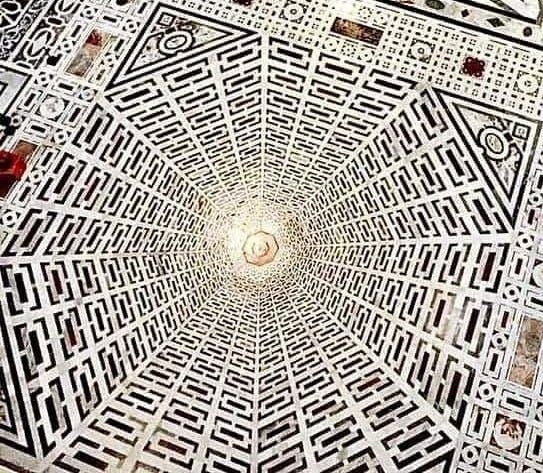

Excerpted from A Whirld of Words: A Reader’s Commonplace Dictionary.
You will find the WORKS CITED below.
infinite
the Pythagoreans identify the infinite with the even; the infinite exhibits itself in different ways – in time, in the generations of man, and in the division of magnitudes
(Aristotle 1990) p. 280, 284
that which leaves always something more to be measured
Aristotle, Physics (Aquinas 1990a) p. 85
that from which, however much we may take, there always remains something to be taken
Aristotle, Physics (Aquinas 1990a) p. 462
it is a doctrine of Aristotle that an infinite can never be actu, in other words, actual and given, but merely potentia
(Schopenhauer 1969) p. 500
in material things the infinite does not exist actually, but only in potency, and so far as one thing succeeds another
(Aquinas 1990a) p. 462
the chaos of infinite time on each side of the present
(Aurelius 1990) p. 249
My bounty is as boundless as the sea,
My love as deep; the more I give to thee,
The more I have, for both are infinite
Juliet (Shakespeare 1990) p. 294
the infinite is unthinkable
Kepler (Koestler 1959) p. 367
my intellect, which is finite, cannot comprehend the infinite; infinite – in which nowhere are limits to be found; the infinite qua infinite is in nowise comprehended, but nevertheless it is understood
(Descartes 1990) p. 336, 338
whoever shall have understood the ultimate principles of being might also attain to the knowledge of the Infinite. The one depends on the other, and one leads to the other
(Pascal 1990) p. 182
toward the end of the seventeenth century, the Pascal triangle facilitated the study of infinite series, the calculus of finite differences, and the theory of probability
(Lach 1977) p. 409
all Greek culture has a horror of the infinite and seeks the metron, the mean
(Ortega y Gasset 1961a) p. 151
I imagine that when we reach the limits of things set for us, or even as we only approach these limits, we gaze into the infinite, just as from the surface of the earth we gaze out into immeasurable space
(Lichtenberg 2012) p. 58
the world of Newton was infinite; but this infinity was not a matter of size, but an empty generalization, an abstract, inane Utopia; the world of Einstein is finite, but full and concrete in all its parts
(Ortega y Gasset 1961b) p. 32
if the doors of perception were cleansed everything would appear to man as it is, infinite
(Gilchrist and Todd 1945) p. 72
infinitely
it is astonishing how much the word infinitely is misused: everything is infinitely more beautiful, infinitely better, etc. The concept must have something pleasing about it, or its misuse could not have become so general
(Lichtenberg 2000) p. 155
infinitive
the word infinitive means not limited
(Hines and Welch 1962) p. 20
there’s a split in the infinitive from to have to have been to will be
(Joyce 1999) p. 271
infinity
all infinity is in some ineffable way made finite to God, for it is comprehensible by His knowledge; Him whose understanding is infinite
(Ps.147.5) (Augustine 1990) p. 409
it is the duty and virtue of all knowledge to abridge the infinity of individual experience
(Bacon 1990) p. 44
for a very long time indeed I could not reconcile personality with infinity; and my head was with Spinoza, though my whole heart remained with Paul and John
(Coleridge 1975) p. 112
there is in man a terrible unsatisfied desire to soar into infinity, a feverish longing to break through the narrow bonds of individuality
Friedrich Schlegel (Berlin 1999) p. 15
the infinity of the cosmos was one of the great intoxicating ideas produced by the Renaissance; Giordano Bruno suffered a cruel death on its behalf
(Ortega y Gasset 1961a) p. 151
the mathematician Georg Cantor demonstrated that infinity has a structure
(Fraser 1981) p. xxxv
abysses
we sail within a vast sphere, ever drifting in uncertainty, driven from end to end. When we think to attach ourselves to any point and to fasten to it, it wavers and leaves us; and if we follow it, it eludes our grasp, slips past us, and vanishes for ever. Nothing stays for us. This is our natural condition, and yet most contrary to our inclination; we burn with the desire to find solid ground and an ultimate sure foundation whereon to build a tower reaching to the Infinite. But our whole groundwork cracks, and the earth opens to abysses
Blaise Pascal (Lowell 2003) p. 1051
Alexander
Alexander once shed tears while listening to Anaxarchus lecture on the existence of an infinite number of worlds. His friends asked him what the matter was, and he replied, ‘Don’t you think tears are called for, if there are an infinite number of worlds, and I’ve not yet gained control of just one?’
(Plutarch 1992) p. 215
aristocracy
to be bred in a place of estimation; to see nothing low and sordid from one’s infancy; to be taught to respect one’s self; to be habituated to the censorial inspection of the public eye; to look early to public opinion; to stand upon such elevated ground as to be enabled to take a large view of the widespread and infinitely diversified combinations of men and affairs in a large society; to have leisure to read, to reflect, to converse; to be enabled to draw and court the attention of the wise and learned, wherever they are to be found; to be habituated in armies to command and to obey; to be taught to despise danger in the pursuit of honour and duty; to be formed to the greatest degree of vigilance, foresight, and circumspection, in a state of things in which no fault is committed with impunity and the slightest mistakes draw on the most ruinous consequences; to be led to a guarded and regulated conduct, from a sense that you are considered as an instructor of your fellow-citizens in their highest concerns, and that you act as a reconciler between God and man; to be employed as an administrator of law and justice, and to be thereby amongst the first benefactors to mankind; to be a professor of high science, or of liberal and ingenious art; to be amongst rich traders, who from their success are presumed to have sharp and vigorous understandings, and to possess the virtues of diligence, order, constancy, and regularity, and to have cultivated an habitual regard to commutative justice: these are the circumstances of men that form what I should call a natural aristocracy, without which there is no nation
Edmund Burke (Kirk 1954) p. 63
atoms
atoms can never come to rest but must ceaselessly move in all directions, pressed together and bouncing apart – to a very great distance or else in some narrow confinement. Consider, too, the peculiar implications: if motion is one uninterrupted chain, each new one the result of something that went before, predictable and constrained, decreed, as it were, by fate, with cause following cause infinitely forward and backward, where would you find free will in living creatures everywhere on earth? But each creature displays an unpredictable nature rested somehow from the fates, so that we go this way or that, at our pleasure or whim, not at fixed times and places, but as our minds dictate!
(Lucretius Carus and Slavitt 2008) p. 52, 58
books
a book is not an isolated being: it is a relationship, an axis of innumerable relationships; a book is more than a verbal structure or series of verbal structures; it is the dialogue it establishes with its reader and the intonation it imposes upon his voice and the changing and durable images it leaves in his memory; this dialogue is infinite
(Borges 1983) p. 213
books ought to have no patrons but truth and reason; the images of men’s wits and knowledges remain in books, exempted from the wrong of time and capable of perpetual renovation. Neither are they fitly to be called images, because they generate still, and cast their seeds in the minds of others, provoking and causing infinite actions and opinions in succeeding ages
(Bacon 1990) p. 10, 28
cave
let us consider the false appearances imposed upon us by every man’s own individual nature and custom, in that feigned supposition that Plato maketh of the cave: although our persons live in the view of heaven, yet our spirits are included in the caves of our own complexions and customs, which minister unto us infinite errors and vain opinions, if they be not recalled to examination
(Bacon 1990) p. 61
Christianity
Christianity is a grand, a holy religion, full of infinite blessedness, a religion that seeks to conquer for the spirit the most absolute domination on earth. But such a religion was far too sublime, far too pure, far too good for this world, where its idea could only be proclaimed in theory, but could never be realized in practice. The attempt to realize it has produced in human history an infinite number of heroic deeds, which will afford to poets of all ages ample themes for story and song. But the endeavor to realize the Christian idea has, as we at last come to see, most lamentably failed, and the abortive attempt has cost humanity incalculable sacrifices; sacrifices whose calamitous effects are visible in the social distemper that afflicts all Europe at the present day
(Heine 1959) p. 75
comet
at this very moment man is so infinitely farther ahead in thought than in being that it is as if he were distended, like a comet
(Miller 1969) p. 193
Creation
the ethical view of the universe involves us at last in so many cruel and absurd contradictions, where the last vestiges of faith, hope, charity, and even of reason itself, seem ready to perish, that I have come to suspect that the aim of creation cannot be ethical at all. I would fondly believe that its object is purely spectacular: a spectacle for awe, love, adoration, or hate, if you like, but in this view – and in this view alone – never for despair! Those visions, delicious or poignant, are a moral end in themselves. The rest is our affair – the laughter, the tears, the tenderness, the indignation, the high tranquillity of a steeled heart, the detached curiosity of a subtle mind – that’s our affair! And the unwearied self-forgetful attention to every phase of the living universe reflected in our consciousness may be our appointed task on this earth. A task in which fate has perhaps engaged nothing of us except our conscience, gifted with a voice in order to bear true testimony to the visible wonder, the haunting terror, the infinite passion and the illimitable serenity; to the supreme law and the abiding mystery of the sublime spectacle
(Conrad 1969) p. 712
death
existence embraces both life and death, and in a way death is the test of the meaning of life. If death is devoid of meaning, then life is absurd. Death is grim, harsh, cruel, a source of infinite grief. Our first reaction is consternation. We are stunned and distraught. Slowly, our sense of dismay is followed by a sense of mystery. Suddenly a whole life has veiled itself in secrecy. Our speech stops, our understanding fails. In the presence of death there is only silence, and a sense of awe
(Heschel and Heschel 1996) p. 366
deserts
deserts are a symbol of the infinite
(Barton 2000) p. 11
Ein Sof
in order to express the unknowable aspect of the Divine the early kabbalists of Provence and Spain coined the term Ein Sof – Infinite. Ein Sof is the absolute perfection in which there are no distinctions and no differentiations. It does not reveal itself in a way that makes knowledge of its nature possible, and it is not accessible even to the innermost thought of the contemplative. In Kabbalah Ein Sof is absolute reality
(Scholem 1978) p. 88, 89, 90
evil
Pythagoreans held evil to be infinite
(Aquinas 1990b) p. 430
falsity
susceptible of infinite combinations; whereas truth has only one form
(Rousseau 1964) p. 49
freedom
freedom in its infinite meanings remains humanity’s most universal aspiration
(Blight 2018) p. 764
God
Spinoza’s famous doctrine: every substance must be infinite, one substance cannot produce another, and therefore there is only one substance. Consequently, whatever exists belongs to that one substance which is God, while Extended and Thinking Nature are hence merely two attributes of the same thing. Accordingly, ‘God is, in relation to his effects or creatures no other than an immanent cause’, that is, the totality of everything, while causality and creation are inherent in, and not external to, that one substance. God’s Providence is redefined as ‘nothing but the striving we find both in Nature as a whole and in particular things, tending to maintain and preserve their being’. Natura naturans, the active or creative power of Nature which is God is distinguished from the actuality and creatures of nature, or Natura naturata. Motion is declared inherent in matter and ‘has been from all eternity and will remain to all eternity, immutable’. Everything which happens occurs necessarily; there ‘are no contingent things’; and nothing can be otherwise than it is
(Israel 2001) p. 162
Spinoza’s God is simply beyond good and evil. Hence there are no vestiges of divine justice to be found except where just men reign. All human acts are modes of the one God, who possesses infinitely many attributes each of which is infinite and only two of which are known to us; who is therefore a mysterious God, whose mysterious love reveals itself in eternally and necessarily bringing forth love and hatred, nobility and baseness, saintliness and depravity; and who is infinitely lovable not in spite of but because of His infinite power which is beyond good and evil
(Strauss 1965) p. 18
nature is motion. The indefinite power to move underlying this motion is conatus. The infinite, and in itself motionless, mind that excites this power is God. The works of nature are brought into being by conatus and brought to perfection by motion. In sum, the genesis of things presupposes motion, motion presupposes conatus, and conatus presupposes God. God shines even in the darkness of errors
(Vico 1988) p. 79, 90
hell
Ruskin: Hell is very likely to be modernization infinitely extended
(Stoppard 1998) p. 14
Herzen, Alexandr
some mysterious force made me live: there was little of my doing in that: a time was chosen for me, and in that is my domain. I have no past upon the earth and in a few years I shall have no future. Whence came this flesh at the solidity of which Hamlet was amazed, I do not know; but life is my natural right: I dispose of it as its master; I thrust my ‘I’ into all that surrounds me; I fight with it; I discover my soul to everyone, and with it I absorb the whole world and melt it down as if in a crucible; I am conscious of a bond with humanity and with infinity: and can the recital of this elaboration, from a child’s spontaneity, from the untroubled sleep in the bosom of its mother, until full consciousness, until its demand to take part in all that is human, until a distinct life of its own – can all this be devoid of interest? It cannot be so
(Herzen et al. 1968) p. 1800
honor
honor is infinitely more valuable than positions of honor
(Lichtenberg 2000) p. 125
I
in infinite time, in infinite matter, in infinite space, has formed a bubble organism, and that bubble lasts a while and bursts, and that bubble is I
(Tolstoy 1965) p. 822
idea
Coleridge says in The Statesman’s Manual, ‘Every idea is living, productive, partaketh of infinity, and (as Bacon has sublimely observed) containeth an endless power of semination’
Elizabeth Sewell (Tagliacozzo and White 1969) p. 125
imagination
that faculty which represents objects, not as they are in themselves, but as they are moulded by other thoughts and feelings, into an infinite variety of shapes and combinations of power
(Hazlitt 1991) p. 312
immortality
the dignity and excellency of knowledge and learning in that whereunto man’s nature doth most aspire, which is immortality or continuance; have not the verses of Homer continued twenty-five hundred years, or more, without the loss of a syllable or letter, during which time infinite palaces, temples, castles, cities, have been decayed and demolished?
(Bacon 1990) p. 28
intellect
I hold that in nature there exists an infinite power of thinking. I hold our human mind to be part of this infinite intellect
Spinoza (Royce 1955) p. 64
Jerome
Jerome understood that nothing is sweeter to a servant of God than studious leisure, than the study of letters through which we learn about the infinity of things and of nature, about the sky, earth, seas, and at last about God himself. He read so much that we can hardly imagine how he found time to write; he wrote so much that it is difficult to believe how he could have found time to read
the mystic Isotta Nogarola (Thornton 1997) p. 4
Latin
we note that he [Lorenzo Valla] who in the preface to the Elegantiae celebrates the Latin language as ‘superb fruit, truly divine food not for the body but for the soul… a medium for the education of all nations in the liberal arts and a gateway to every form of knowledge’, in the Dialogue on Pleasure calls that same language defective when compared with Greek, because it is too meager in words capable of depicting the infinite diversity of human actions
(Valla et al. 1977) p. 12
life
I’ve thought of a simile to describe human life as a whole. You know those bubbles that rise to the surface below a waterfall – those little pockets of air that combine to produce foam? Some of them are quite tiny, and burst and disappear immediately, but others last a bit longer, and by absorbing the bubbles around them swell up to a monstrous size, until eventually they burst too – for it’s the inevitable end of the process. Well, that’s what human beings are like. They’re all more or less inflated pockets of air. Some of them stay blown up for an infinitesimal space of time, while others disintegrate the moment they’re produced – but sooner or later they’re all bound to go pop
(Lucian 1990) p. 92
love
an attitude maintained by the infinite toward the finite
(Brodsky 1986) p. 44
man
what is man in nature? A Nothing in comparison with the Infinite, an All in comparison with the Nothing, a mean between nothing and everything. Since he is infinitely removed from comprehending the extremes, the end of things and their beginning are hopelessly hidden from him in an impenetrable secret; he is equally incapable of seeing the Nothing from which he was made, and the Infinite in which he is swallowed up
(Pascal 1990) p. 182
mankind cannot subsist at all unless there is an infinite number of useful men who possess nothing at all. It is hardly possible to read history without conceiving a horror of mankind
(Voltaire 1972) p. 183, 249
what a thing is Man, this lauded demi-god! Does he not lack the very powers he has most need of? And if he should soar in joy, or sink in sorrow, is he not halted and returned to his cold, dull consciousness at the very moment he was longing to be lost in the vastness of infinity?
(Goethe 1989) p. 105
meaning
understanding the meaning of a word in our mother tongue often takes us many years. I also have in mind understanding the meaning tone can lend to a word. The meaning of a word is, if I may express myself mathematically, given by a formula in which the tone is the variable and the word is the constant quantity. This opens the possibility of infinitely enriching language without increasing the number of words. I have found that the phrase ‘It is good’ is pronounced in five different ways, each time with another meaning, which is often determined by yet a third variable, namely, the facial expression
(Lichtenberg 2012) p. 33
memory
this power of memory is great, very great, my God. It is a vast and infinite profundity. Who has plumbed its bottom? This power is that of my mind and is a natural endowment, but I myself cannot grasp the totality of what I am. Is the mind, then, too restricted to compass itself, so that we have to ask what is that element of itself which it fails to grasp? Surely that cannot be external to itself; it must be within the mind. How then can it fail to grasp it? This question moves me to great astonishment. Amazement grips me
(Augustine 1991) p. 187
mind
the human mind is a part of the infinite intellect of God, and therefore, when we say that the human mind perceives this or that thing, we say nothing else than that God has this or that idea. He is manifested through the nature of the human mind, or in so far as He forms the essence of the human mind
(Spinoza 1990) p. 611
modern world
the modern world is fundamentally uncontrollable and unpredictable. Modern society is a complex system, seemingly stable, teetering on the edge of chaos – until everything falls apart due to a small change, from the accidental to the infinitesimal. When complex systems are designed for a little less optimization and a little more flexibility, they’re more resilient
(Klaas 2024) p. 98, 102
myself
I have no need to traverse heaven and earth to uncover a wondrous object full of contrast, of infinite greatness and smallness, of intense gloom and astounding light, capable at the same time of exciting piety, admiration, scorn, and terror. I need only contemplate myself: man emerges from nothing, passes through time and disappears forever into the bosom of God. He is seen wandering for a brief time along the edge of these two chasms and then is lost. However, man is sufficiently revealed for him to perceive something of himself but sufficiently obscure for the rest to be buried in impenetrable darkness, into which he gropes again and again without success in order to complete his self-knowledge
(Tocqueville 2003) p. 564, 565
nature
we may easily conceive the whole of nature to be one individual, whose parts, that is to say, all bodies, differ in infinite ways without any change of the whole individual
(Spinoza 1990) p. 614
nonlinear space-time diffeomorphisms
self-mappings of the space-time manifold that are infinitely differentiable but not necessarily analytic
(Sokal 2000) p. 16
novel
Kafka’s novels take place in infinity
(Heller 1959) p. 200
people
MACHIAVELLI: You [Montesquieu] are a great thinker but you do not appreciate the infinite baseness of the people. I am not describing those of my time but those of yours. They grovel in the face of strength and are without pity in the face of weakness. They are implacable in the face of trifling faults and indulgent toward crimes. They are incapable of tolerating the frustrations of a free society and patient to the point of martyrdom with all the outrages of audacious despotism. They overturn thrones in moments of anger. They hand themselves over to masters in whom they pardon outrages which, for much slighter reason, they would have decapitated twenty constitutional kings
(Joly and Waggoner 2002) p. 25
perception
if the doors of perception were cleansed, everything would appear to man as it is, infinite
(Blake 1979) p. 93
philanthropy
the field of contemporary philanthropy, or noncommercial investment, is a labyrinth of mirrors, flashing lights, fitful shadows, and pervasive ballyhoo. One can be sure of little in this maze, for everything superficially perceptible is an illusion multiplied to infinity. Rockefeller, in all his miscellaneous ‘giving’, was not really giving at all: he was buying
(Lundberg 1960) p. 320, 333
poetic imagination
a repetition in the finite mind of the eternal act of creation in the infinite I am
Coleridge (Rees 1971) p. 185
poetry
putting the infinite within the finite
Robert Browning (Marshall 1966) p. 195
providence
religious truth – the world is not abandoned to chance and external accident but controlled by Providence. The truth that a Providence, that is to say, a divine Providence, presides over the events of the world corresponds to our principle; for divine Providence is wisdom endowed with infinite power which realizes its own aim, that is, the absolute, rational, final purpose of the world
(Hegel 1953) p. 14, 15
quantum theory
quantum theory does not allow a completely objective description of nature; quantum theory is connected with a universal constant of nature, Planck’s quantum of action. An objective description for events in space and time is possible only when we have to deal with objects or processes on a comparatively large scale, where Planck’s constant can be regarded as infinitely small
(Heisenberg 1958) p. 106, 164
racism
Frederick Douglass minced no words, calling the infinite manifestations of racism a ‘National faith’
(Blight 2018) p. 645
reality
according to Max Weber, reality is an infinite and meaningless sequence, or a chaos, of unique and infinitely divisible events, which in themselves are meaningless: all meaning, all articulation, originates in the activity of the knowing or evaluating subject
(Strauss 1953) p. 77
reason
your reason is never more plausible and on more solid ground than when it convinces you of the plurality of worlds:
That earth, and sun, and moon, and all that we behold
Are not unique, but infinitely manifold.
Wherefore we must conclude on every ground
That elsewhere other piles of matter, bound
Like this one by the ether, do exist
Lucretius (Montaigne 1958) p. 390
relativity
the decisive step was taken in the paper by Einstein in 1905. The decisive change was in the structure of space and time. It is very difficult to describe this change in the words of common language, without the use of mathematics, since the common words ‘space’ and ‘time’ refer to a structure of space and time that is actually an idealization and oversimplification of the real structure. In classical theory we assume that future and past are separated by an infinitely short time interval which we may call the present moment. In the theory of relativity we have learned that the situation is different: future and past are separated by a finite time interval the length of which depends on the distance from the observer. Any action can only be propagated by a velocity smaller than or equal to the velocity of light. Perhaps the most important consequence of the principle of relativity is the inertia of energy, or the equivalence of mass and energy. Since the velocity of light is the limiting velocity which can never be reached by any material body, it is more difficult to accelerate a body that is already moving very fast than a body at rest. The inertia has increased with the kinetic energy. But quite generally any kind of energy will, according to the theory of relativity, contribute to the inertia, i.e., to the mass, and the mass belonging to a given amount of energy is just this energy divided by the square of the velocity of light. Therefore, every energy carries mass with it; but even a rather big energy carries only a very small mass. The cornerstone of the theory of general relativity is the connection between inertia and gravity. Very careful measurements have shown that the mass of a body as a source of gravity is exactly proportional to the mass as a measure for the inertia of the body. The theory of relativity is connected with a universal constant in nature, the velocity of light. This constant determines the relation between space and time
(Heisenberg 1958) p. 114-117, 164
religion
feeling and taste for the Infinite
Schleiermacher (Mann 1948) p. 88
Rome
Rome conquered Italy, and ultimately the world, at the cost of infinite suffering to the nations and great degeneration at home
(Burckhardt 1979) p. 322
scholastic method
the scholastic method was a development of the florilegium. In its simplest form, it was an attempt to solve by infinitely patient criticism and subtlety of distinction the problems posed by the juxtaposition of related but often divergent passages in the works of the great Christian writers. It was, one might say, the attempt of the intellect to discover and articulate the whole range of truth discoverable in, or hinted at in, the seminal works of Christianity
(Southern 1953) p. 191
soul
although the desire to obtain the good things of this world is the dominant passion of Americans, there are moments of respite when their souls appear suddenly to break the physical ties which hold them back and to rush impetuously toward heaven. It is not man who has inspired in himself the taste for infinite things and the love of what is everlasting. These lofty instincts are not the offspring of some whimsical desire; they have their firm foundations in human nature and exist despite man’s efforts. Man can impede and disfigure them but he cannot destroy them. The soul has needs which must be satisfied. Whatever efforts are expended upon diverting it from itself, it soon grows weary, anxious, and restless amid the pleasures of the senses
(Tocqueville 2003) p. 621
space
as in the General Scholium which concluded the later editions of the Principia, young Newton stressed the real, ubiquitous presence of God in all space, which he (unlike Descartes) believed to be infinite, because God is infinite. Perhaps, he speculated, it is the constant (not only once in the past) volition of God that differentiates certain particles of space so that by us they are discerned as particles of matter – obviously in the composite form of tangible bodies. The constant presence of God may thus be matched by a constant creation of matter
(Hall 1992) p. 75
even pantheistic philosophy is a religion of space: the Supreme Being is thought to be the infinite space. Deus sive natura has extension, or space, as its attribute, not time; time to Spinoza is merely an accident of motion, a mode of thinking. And his desire to develop a philosophy more geometrico, in the manner of geometry, which is the science of space, is significant of his space-mindedness. it is the realm of space where imagination wields its sway
(Heschel 2005) p. 4
Spinoza, Baruch
Spinoza teaches: infinite thought and infinite extension are the two attributes of the absolute substance
(Heine 1959) p. 72
sublime
Edmund Burke, in his famous essay on the sublime (1757), the most influential tract on aesthetics ever published in the Anglo-Saxon world – it affected thinking on art as much as Adam Smith’s Wealth of Nations (1776) revolutionized business theory – lists the qualities of the sublime as Astonishment, Terror, Obscurity, Power, Privation (Vacuity, Darkness, Solitude and Silence), Vastness, Infinity, Succession and Uniformity, Magnificence, Light, Colour, Magnitude in Building and Difficulty
(Johnson 1991) p. 187
truth
the active pursuit of truth is our proper business, we have no excuse for conducting it badly or unfittingly; but failure to capture our prey is another matter, for we are born to quest after it; to possess it belongs to a greater power; truth is not, as Democritus said, hidden in the depths of the abyss, but situated rather at an infinite height in the divine understanding; the world is but a school of inquiry
(Montaigne 1959) p. 292
the possibility that gigantic lies and monstrous falsehoods can eventually be established as unquestioned facts – the difference between truth and falsehood may cease to be objective and become a mere matter of power and cleverness, of pressure and infinite repetition
(Arendt 1958) p. 333
truth is the correspondence of the finite to the infinite
(Heschel and Heschel 1996) p. 59
words
just as there are polysyllabic words that say very little, so there are also monosyllabic words of infinite meaning
(Lichtenberg 2000) p. 120
world
the terms madman, dreamer, visionary are appropriate to anybody who claims that the fortuitous meetings of an infinity of corpuscles has produced the world and is the continual cause of generations
(Bayle 1965) p. 127
only a mass of molecules, loaded like dice in an infinity of different ways; there is a law of necessity that works without design, without effort, without intelligence, without progress
Diderot (Crocker 1966) p. 323

LINK to the Introduction to A Whirld of Words: A Reader’s Commonplace Dictionary.

Thank you for your support.
Please RESTACK this Post and RECOMMEND A Worlde of Wordes.
SUBSCRIBE to receive daily Posts.
Enjoy!
WORKS CITED
Aquinas, Thomas (1990a), Summa Theologica Vol. I (Great Books of the Western World, 17; Chicago: Encyclopaedia Britannica) xvi, 826.
--- (1990b), Summa Theologica Vol. II (Great Books of the Western World, 18; Chicago: Encyclopaedia Britannica) xiv, 1085.
Arendt, Hannah (1958), The Origins of Totalitarianism (2d enl. edn.; New York: Meridian Books) 520.
Aristotle (1990), Prior Analytics; Posterior Analytics; Topics; Sophistical Refutations; Heavens; Metaphysics; Soul; Memory Vol. I (Great Books of the Western World, 7: Encyclopaedia Britannica) viii, 726.
Augustine (1990), The City of God (Great Books of the Western World, 16: Encyclopaedia Britannica) xiv, 784.
--- (1991), Confessions, trans. Henry Chadwick (New York: Oxford University Press) xxviii, 311.
Aurelius, Marcus (1990), The Meditations of Marcus Aurelius (Great Books of the Western World, 11; Chicago: Encyclopaedia Britannica) 233-94.
Bacon, Francis (1990), Of the Proficience and Advancement of Learning Divine and Humane (Great Books of the Western World, 28; Chicago: Encyclopaedia Britannica) i, 101.
Barton, Bruce (2000), The Man Nobody Knows: A Discovery of the Real Jesus (Chicago: I.R. Dee) xxvi, 102.
Bayle, Pierre (1965), Historical and Critical Dictionary: Selections (Indianapolis: Bobbs-Merrill) xliv, 456.
Berlin, Isaiah (1999), The Roots of Romanticism (Princeton: Princeton University Press) xvi, 171.
Blake, William (1979), Blake’s Poetry and Designs: Authoritative Texts, Illuminations in Color and Monochrome, Related Prose, Criticism (New York: Norton) xlviii, 618 p., 32 leaves of plates.
Blight, David W. (2018), Frederick Douglass: Prophet of Freedom (New York: Simon and Schuster) xx, 888.
Borges, Jorge Luis (1983), Labyrinths: Selected Stories and Other Writings (New York: Modern Library) xxiii, 251.
Brodsky, Joseph (1986), Less Than One: Selected Essays (New York: Farrar, Straus & Giroux) 501.
Burckhardt, Jacob (1979), Reflections on History (Indianapolis: Liberty Classics) 353, 1 pl.
Coleridge, Samuel Taylor (1975), Biographia Literaria: Or, Biographical Sketches of My Literary Life and Opinions (New York: Dutton) xxvi, 303.
Conrad, Joseph (1969), The Portable Conrad (New York: Viking Press) vi, 762.
Crocker, Lester G. (1966), Diderot (New York: Free Press) 420.
Descartes, René (1990), Meditations on First Philosophy (Great Books of the Western World, 28; Chicago: Encyclopaedia Britannica) 293-519.
Fraser, J. T. (1981), The Voices of Time: A Cooperative Survey of Man’s Views of Time as Expressed by the Sciences and by the Humanities 2 Vols. (2nd edn.; Amherst: University of Massachusetts Press) lx, 710.
Gilchrist, Alexander and Todd, Ruthven (1945), The Life of William Blake (New York: Dutton) xi, 422, 4.
Goethe, Johann Wolfgang von (1989), The Sorrows of Young Werther (New York: Penguin) 144.
Hall, A. Rupert (1992), Isaac Newton, Adventurer in Thought (Cambridge, Mass.: Blackwell) xv, 468.
Hazlitt, William (1991), Selected Writings (The World’s Classics; New York: Oxford University Press) xlvi, 423.
Hegel, Georg Wilhelm Friedrich (1953), Reason in History: A General Introduction to the Philosophy of History (New York: Liberal Arts Press) xlii, 95.
Heine, Heinrich (1959), Religion and Philosophy in Germany: A Fragment (Boston: Beacon Press) xxiii, 177.
Heisenberg, Werner (1958), Physics and Philosophy: The Revolution in Modern Science (New York: Harper) 206.
Heller, Erich (1959), The Disinherited Mind (New York: Meridian Books) 306.
Herzen, Aleksandr, Garnett, Constance, and Higgens, Humphrey (1968), My Past and Thoughts: The Memoirs of Alexander Herzen: Vol. 4, 4 vols. (New York: Knopf) vi, 1515-908.
Heschel, Abraham Joshua (2005), The Sabbath: Its Meaning for Modern Man (New York: Farrar, Straus and Giroux) xvi, 118.
Heschel, Abraham Joshua and Heschel, Susannah (1996), Moral Grandeur and Spiritual Audacity: Essays (New York: Farrar, Straus & Giroux) xxx, 428.
Hines, Therese and Welch, Edward (1962), Our Latin Heritage, Vol. 1, 2 vols. (New York: Harcourt Brace and World) xiv, 434.
Israel, Jonathan I. (2001), Radical Enlightenment: Philosophy and the Making of Modernity, 1650-1750 (New York: Oxford University Press) xvi, 810.
Johnson, Paul (1991), The Birth of the Modern: World Society, 1815-1830 (New York: HarperCollins) xx, 1095.
Joly, Maurice and Waggoner, John S. (2002), The Dialogue in Hell between Machiavelli and Montesquieu (Lanham, Md.: Lexington Books) xxv, 394.
Joyce, James (1999), Finnegans Wake (Penguin Books) xxxiv, 628.
Kirk, Russell (1954), The Conservative Mind (London: Faber and Faber) 480.
Klaas, Brian (2024), Fluke: Chance, Chaos, and Why Everything We Do Matters (New York: Scribner) ix, 323.
Koestler, Arthur (1959), The Sleepwalkers: A History of Man’s Changing Vision of the Universe (New York: Macmillan) 624.
Lach, Donald F. (1977), Asia in the Making of Europe, Vol. II A Century of Wonder: Book Three, The Scholarly Disciplines (Chicago: University of Chicago Press) xii, 395-764.
Lichtenberg, Georg Christoph (2000), The Waste Books, trans. R. J. Hollingdale (New York: New York Review Books) xxv, 235.
--- (2012), Georg Christoph Lichtenberg: Philosophical Writings, trans. Steven Tester (Albany: State University of New York Press) xvi, 207.
Lowell, Robert (2003), Collected Poems (New York: Farrar, Straus and Giroux) xvii, 1186.
Lucian (1990), Satirical Sketches (Bloomington: Indiana University Press) 320.
Lucretius Carus, Titus and Slavitt, David R. (2008), De rerum natura: The Nature of Things: A Poetic Translation (Berkeley: University of California Press) xiv, 301.
Lundberg, Ferdinand (1960), America’s Sixty Families (New York: Citadel Press) xxiii, 578.
Mann, Thomas (1948), Doctor Faustus: The Life of the German Composer, Adrian Leverkühn (New York: A. A. Knopf) vi, 510.
Marshall, William Harvey (1966), The Major Victorian Poets: An Anthology (New York: Washington Square Press) xxix, 786.
Miller, Henry (1969), The Books in My Life (New York: New Directions) 316.
Montaigne, Michel de (1958), Complete Essays, trans. Donald Murdoch Frame (Stanford University Press) xxiii, 883.
--- (1959), Essays, trans. J. M. Cohen (Penguin Books) 405.
Ortega y Gasset, José (1961a), The Modern Theme (New York: Harper) 152.
--- (1961b), The Revolt of the Masses (London: Unwin Books) 144.
Pascal, Blaise (1990), The Provincial Letters; Pensées (Great Books of the Western World, 30; Chicago: Encyclopaedia Britannica) x, 487.
Plutarch (1992), Essays (New York: Penguin Books) 430.
Rees, Joan (1971), Fulke Greville, Lord Brooke, 1554-1628 A Critical Biography (Berkeley: University of California Press) xiv, 238.
Rousseau, Jean-Jacques (1964), The First and Second Discourses (New York: St. Martin’s Press) 248.
Royce, Josiah (1955), The Spirit of Modern Philosophy (New York: G. Braziller) xix, 519.
Scholem, Gershom Gerhard (1978), Kabbalah (New York: Penguin Books) 494.
Schopenhauer, Arthur (1969), The World as Will and Representation, Vol. I, 2 vols. (New York: Dover Publications) xxxii, 534.
Shakespeare, William (1990), Romeo and Juliet (Great Books of the Western World, 24; Chicago: Encyclopaedia Britannica) 285-319.
Sokal, Alan D. (2000), The Sokal Hoax: The Sham that Shook the Academy (Lincoln: University of Nebraska Press) ix, 271.
Southern, R. W. (1953), The Making of the Middle Ages (New Haven: Yale University Press) 280.
Spinoza, Benedict (Baruch) de (1990), Ethics (Great Books of the Western World, 28; Chicago: Encyclopaedia Britannica) 583-697.
Stoppard, Tom (1998), The Invention of Love (New York: Grove Press) v, 102.
Strauss, Leo (1953), Natural Right and History (Chicago: University of Chicago Press) x, 327.
--- (1965), Spinoza’s Critique of Religion (New York: Schocken Books) 351.
Tagliacozzo, Giorgio and White, Hayden V. (1969), Giambattista Vico: An International Symposium (Baltimore: Johns Hopkins Press) xxvi, 636.
Thornton, Dora (1997), The Scholar in His Study: Ownership and Experience in Renaissance Italy (New Haven: Yale University Press) xi, 214.
Tocqueville, Alexis de (2003), Democracy in America: and Two Essays on America (London: Penguin) lii, 935.
Tolstoy, Leo (1965), Anna Karenina (New York: Random House) xxiii, 855.
Valla, Lorenzo, Hieatt, A. Kent, and Lorch, Maristella De Panizza (1977), On pleasure = De Voluptate (New York: Abaris Books) 417.
Vico, Giambattista (1988), On the Most Ancient Wisdom of the Italians: Unearthed from the Origins of the Latin Language: Including the disputation with the Giornale de’ letterati d’Italia, trans. L. M. Palmer (Ithaca: Cornell University Press) xi, 198.
Voltaire (1972), Philosophical Dictionary (Hammondsworth: Penguin) 400.
A wondrous topic which has always fascinated. I’m no better than a poor undergraduate mathematician (or was, decades ago), but I enjoyed David Foster Wallace’s book on the subject and pursued this a little further.
Cantor’s countable and non-countable infinities (if, indeed, I recall the terminology accurately) took me a long time to think around as the mathematics was too splendid! I am no set theorist 😂. Thank you for helping me remember this.